
Linq vs Twilio: pay per contact, not per message
Linq’s contact-based pricing structure is built for high-volume AI conversations. Twilio bills every SMS and RCS segment, sent or received, plus carrier fees.

Trusted by 1,000+ teams








Four differences that matter
Where Linq and Twilio actually diverge for teams building agents.
No per-message fees
Twilio bills US SMS and RCS per segment, $0.0083 per segment sent and received plus carrier fees. Linq prices per contact, with unlimited messages.
Linq: per contact, unlimited messages
Twilio: $0.0083 per segment, plus carrier fees
No registration required
US business texting on Twilio starts with A2P 10DLC brand registration, campaign vetting and monthly campaign fees, and unregistered traffic is blocked. Your Linq line is ready in minutes.
Linq: 3-minute setup
Twilio: 10DLC registration, 1–3 weeks
Apple Messages for Business, live
Linq is an approved Apple Messages for Business provider, with Apple Pay and App Extensions inside the thread. Twilio lists Apple Messages for Business as a private beta.
Linq: live, approved provider
Twilio: private beta
Zero data retention, included
Linq keeps no message data, and message content is encrypted and inaccessible even to Linq. On Twilio, message bodies stay visible in the Console and API unless you buy a Twilio Editions package, its paid enterprise add-on, and request Message Redaction.
Linq: zero data retention
Twilio: redaction is a paid add-on
Finish the task in the thread.
App Extensions and Apple Pay in Apple Messages for Business let your agent take the booking or the payment inside the conversation, not just send a link to it.

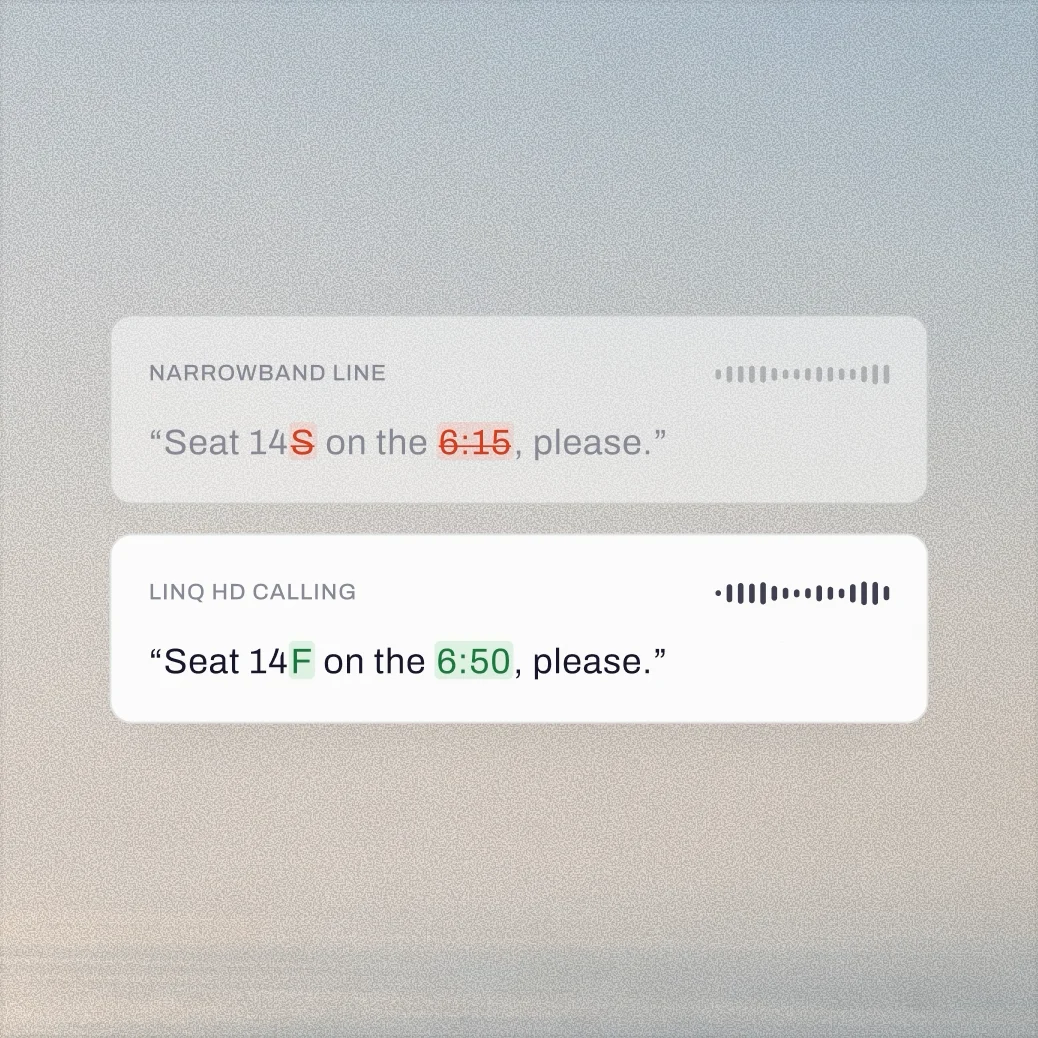
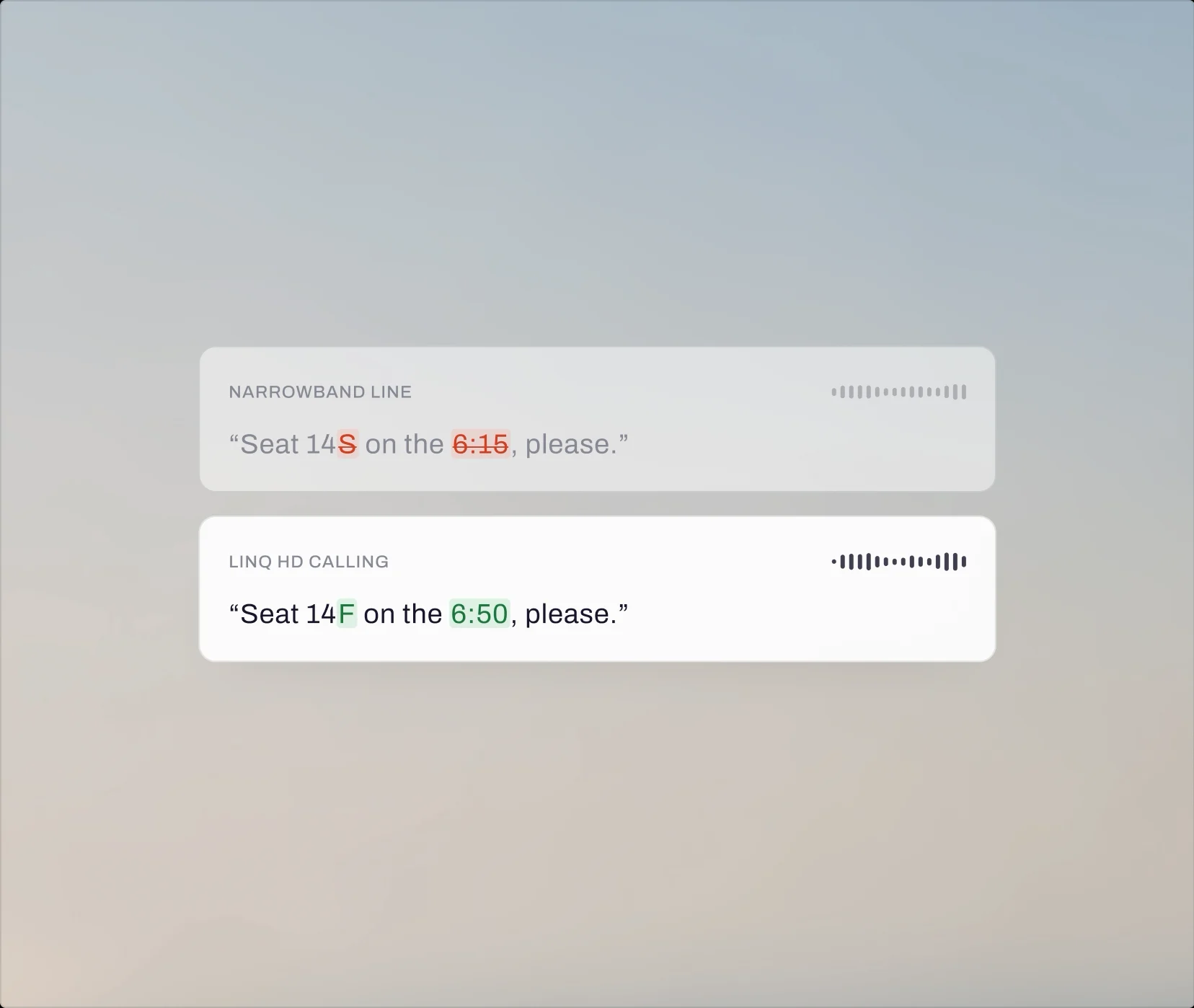
Hear every word.
Fuller, clearer speech in both directions whenever the other phone supports HD. Your agent catches names, numbers, and addresses the first time.
Feature by feature
How Linq and Twilio stack up for teams putting an agent in front of customers.
| Feature | Linq | Twilio |
|---|---|---|
| Pricing | ||
| Pricing model | Per contact, unlimited messages | Pay as you go, per segment or message |
| US SMS | Unlimited messages | $0.0083 per segment, sent or received, plus $0.0035–$0.005 carrier fee per outbound segment |
| RCS | Unlimited messages | $0.0083 per Rich segment plus carrier fees; Rich Media $0.022 per message |
| Registration fees | None | 10DLC brand $4.50–$46, $15 campaign vetting, $1.50–$10 per campaign per month |
| Support | Dedicated support channel on Business; forward-deployed engineers on Enterprise | Free developer support; paid plans from the greater of $250/month or 4% of spend |
| Channels and agent features | ||
| Apple Messages for Business | Live, approved provider | Private beta |
| RCS for Business | Live | Generally available |
| In-thread checkout | Apple Pay and App Extensions | Apple Messages for Business in private beta |
| Agent payments | Agent Card: single-use virtual cards your agent buys with | Not documented |
| Voice | HD voice on native mobile numbers | Per-minute calling; ConversationRelay for AI voice at $0.07/min |
| Launch, webhooks and reliability | ||
| Time to first message | 3-minute setup, free sandbox | US SMS needs 10DLC registration first: 1–3 weeks of brand and campaign review |
| Webhook events | 66 versioned event types | 13 message status values via status callbacks |
| Webhook retries | Managed retries for 30 min (~10 attempts) | 1 retry on connection failure by default, configurable up to 5 |
| Uptime SLA | 99.95%, contractual | 99.95% API availability; 99.99% with Enterprise Edition |
| Data and security | ||
| Message data | Zero data retention; content inaccessible even to Linq | Visible in Console and API unless redacted; redaction needs a paid Twilio Editions package |
| SOC 2 | SOC 2 Type I and Type II | SOC 2 Type I and Type II |
| Where Twilio has an edge | ||
| Footprint | 1B+ messages processed, 1,000+ teams | 180+ countries and territories, 4,800 carrier connections |
| Channel catalog | Apple Messages for Business, RCS, WhatsApp, SMS, voice; Slack and Telegram coming | SMS, MMS, RCS, WhatsApp, Messenger, email, voice, plus the Flex contact center |
| Other certifications | SOC 2 Type I and Type II | ISO/IEC 27001, 27017 and 27018; PCI DSS Level 1 |
Pricing model
US SMS
RCS
Registration fees
Support
Apple Messages for Business
RCS for Business
In-thread checkout
Agent payments
Voice
Time to first message
Webhook events
Webhook retries
Uptime SLA
Message data
SOC 2
Footprint
Channel catalog
Other certifications
Twilio details from twilio.com. Updated Nov 24, 2026.
1B+ messages and counting.
Pioneers building a conversational future.
“We knew Linq would care about reliability and details that would allow us to build a world class product.”

Co-founder and CEO

“Linq is an N of 1 company. Soon all apps will follow DoorDash’s lead and become conversational.”

Head of AI Research

“The folks at Linq have always been super gracious, helpful, and responsive. That’s been the case whenever we’ve needed to grow.”

Co-founder and CEO

Linq vs Twilio, answered
What is the difference between Linq and Twilio?
Twilio is a communications platform that bills per message or per minute across SMS, MMS, RCS, WhatsApp, email and voice, in 180+ countries and territories. Linq is the infrastructure platform for AI agents: it puts your agent on Apple Messages for Business, RCS for Business, WhatsApp, SMS and HD voice with per-contact pricing and unlimited messages, zero data retention, and 99.95% uptime under a contractual SLA. Linq is built for agents that hold conversations; Twilio’s breadth suits teams that need global reach or many channels from one vendor.
How much does Twilio charge per message in the US?
As of November 2026, Twilio lists US SMS at $0.0083 per segment, sent or received, plus carrier pass-through fees of $0.0035 to $0.005 per outbound segment depending on the carrier. RCS Rich messages are also $0.0083 per segment plus carrier fees, Twilio adds $0.005 per WhatsApp message on top of Meta’s fees, and a message that ends in a failed status carries a $0.001 processing fee. Linq prices per contact, with unlimited messages.
Why does per-message pricing matter for AI agents?
An agent earns its keep in the back-and-forth: clarifying questions, confirmations, follow-ups. Under per-message pricing every one of those turns is billed, in both directions, and a long reply is split into 160-character segments that are billed separately. A single emoji switches the encoding and cuts each segment to 70 characters. So the better the conversation, the bigger the bill. Linq prices per contact with unlimited messages, so a longer conversation does not cost more.
Do I need A2P 10DLC registration to send with Linq?
Not for your Linq line. A2P 10DLC brand registration, campaign vetting and monthly campaign fees are carrier requirements for business texting from US 10-digit numbers. Twilio blocks unregistered 10DLC traffic and quotes up to five business days for campaign vetting, seven business days or more when a brand needs manual review, and a fresh review for every resubmitted campaign, so registration typically runs one to three weeks; toll-free numbers need verification, and Twilio puts short codes at six to ten weeks. On Linq you can go from a free sandbox to a real message in about three minutes. Messages that fall back to RCS or SMS travel over the carrier network, where the usual carrier rules apply.
Does Twilio support Apple Messages for Business?
Twilio lists Apple Messages for Business as a private beta, and its product page asks businesses to request access. Linq is an approved Apple Messages for Business provider and the channel is live, including Apple Pay and App Extensions inside the thread.
How do Linq and Twilio handle message data?
Linq has zero data retention: no message data is retained, and message content is encrypted and inaccessible even to Linq. Linq is SOC 2 Type I and Type II certified, with 70 monitored controls. On Twilio, message bodies stay visible in the Console and API unless you request Message Redaction, which is available only to customers who buy a Twilio Editions package, Twilio’s paid enterprise add-on.
How do I move from Twilio to Linq?
Start in the free sandbox: connect your agent to Linq’s API and webhooks and send a real message in about three minutes. When you are ready to move production traffic, Enterprise plans include forward-deployed engineers to help with the cutover, and you can start with a 7-day free trial.

What will you build?
Every messaging channel in one platform. Built for agentic communication to feel like human connection.