By betting on iMessage as the channel and Linq as the infrastructure, Tomo built a deeply personal AI product for young people and scaled it from a single phone line to hundreds of thousands of messages through organic growth alone.
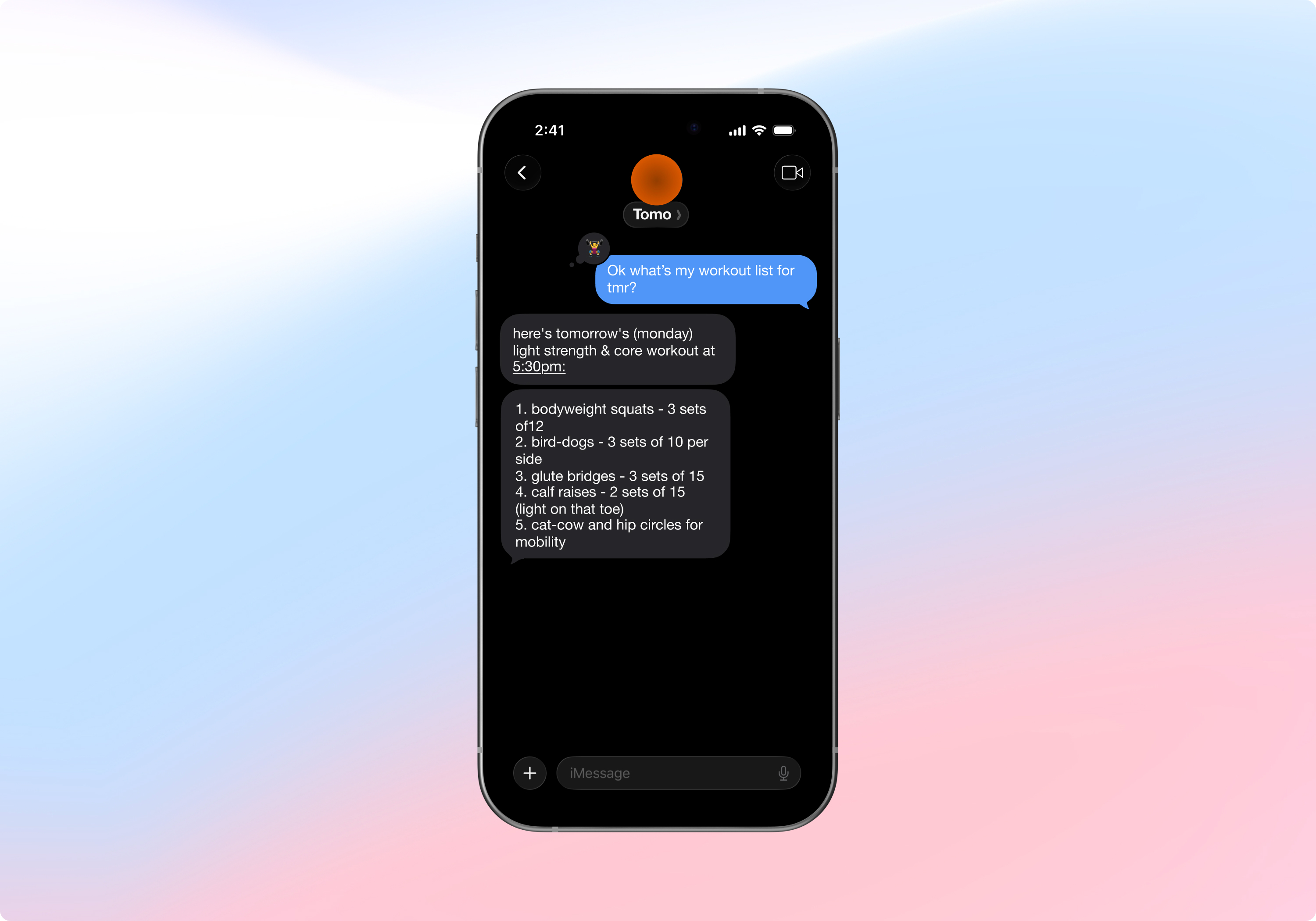
Tomo is a personalized AI that lives inside iMessage. It understands users' goals, affirms them, and helps them find ways to achieve those goals. The name means "friend" in Japanese, and there's a friendliness to the product that's core to why it works. Most of Tomo's users are between 15 and 24 years old, and if you try using it, the experience is, as the founders put it, "aggressively Gen Z coded."
Behind that experience is a messaging infrastructure challenge that required the right partner. With Linq, Tomo found a provider that matched their standards on reliability and security, and then kept pace as organic growth pushed their volume from a single phone line to hundreds of thousands of messages.
From Retool to Tomo
Justin and Raymond, Tomo's co-founders, met while working together at Retool in San Francisco. About a couple of years ago, they left to start separate companies. Justin wanted to build something fun enough for a lot of people to use. Raymond wanted to build something practical with wide-scale impact on real people.
They spent about a year and a half exploring different areas before reuniting around a shared conviction: they wanted to build consumer AI products together.
"My goal has always been to build for impact and actually deliver value to people. I think what's exciting about Tomo is just seeing that in real time." — Raymond, Co-founder
The result was Tomo: an AI that understands the user's goals, why they care about those goals, and helps them take action. It lives entirely inside iMessage, meeting young users in the app they already use every day.

Betting on iMessage
The decision to build on iMessage was straightforward. Tomo's target audience, 15-to-24-year-olds, lives inside the app. People chat a hundred times a day in a space where ten close friends and family members are already texting. For this demographic, anything other than a blue bubble feels like spam.
"It doesn't take a rocket scientist to know that iMessage is so overpowered. It's almost so overpowered that it's difficult, because you can have a product that isn't really working, but you might think it's working just because iMessage is just so good." — Justin, Co-founder
That power cut both ways. iMessage distribution was a massive advantage, but it also meant they needed infrastructure they could trust completely. The channel was too important to get wrong.
From building it themselves to finding Linq
Tomo's engineering team was confident. They had phones from other projects, strong technical chops, and the conviction that they could build iMessage infrastructure in-house. They got something working quickly. But it didn't last.
They evaluated providers across multiple companies. The conclusion was clear: the folks at Linq were the best people for the job. The evaluation criteria came down to security, latency, reliability, and price. But above all, Tomo optimized for reliability.
"You can build a lot of trust for users over 2,000 messages, but it only takes two or three message failures, or even just one, to break that trust."
When users start caring about privacy, you're winning
Tomo's users share deeply personal information through the product. The things they use Tomo for — their goals, their struggles, their daily lives — are hyper personal. That creates a real obligation around data security, and it makes compliance like SOC 2 matter in practice, not just on paper.
What surprised the team was an emerging signal they didn't expect. As users went deeper into the product, they started asking about data privacy. Not because something went wrong, but because they'd shared so much that the question became personal.
From a single phone line to hundreds of thousands of messages
Tomo launched with a single phone line. The first users were the founders themselves, testing with friends, watching hundreds of messages flow through each day, and asking the fundamental question: does this thing have legs?
It did. When the team started promoting on TikTok and Instagram Reels, where their users actually live, demand took off. Through it all, the Linq team kept pace. Five months in, they went from hundreds of messages a day to hundreds of thousands.
Engagement and retention that finally work
Justin and Raymond have built many consumer products before. But Tomo is the first time they've seen engagement and retention levels where things are clearly starting to work.
The team is now focused on making Tomo more helpful and fun to use with friends. One example: group chats — currently a hidden feature that only the most curious users have discovered, but one the team sees as a natural extension of the product.
What's next
Tomo's story is still early. The team sees a massive opportunity to scale the product's impact across millions of people, and they're hiring across growth, ops, and engineering to get there. The infrastructure that Linq provides — reliable, secure, and able to scale on demand — is what lets them focus on the product instead of the plumbing.
"The folks at Linq have always been super gracious and helpful and super responsive. That's been the case whenever we've needed to grow." — Justin, Co-founder, Tomo