If your AI agent needs to communicate with users over text, the messaging API you choose shapes the entire experience.
It determines whether the agent can respond to messages, how quickly it can process responses, which channels it can reach, how much each conversation costs, and how much infrastructure your team has to manage.
This guide compares seven of the best messaging APIs for AI agent builders. We look at channel support, latency, reliability, pricing, onboarding, and how well each platform supports ongoing conversations.
What to look for in a messaging API for AI agents
AI agents need more from a messaging API than just the ability to send a text. If the agent is expected to hold ongoing conversations, respond quickly, and work across multiple channels, the API has to support that interaction without adding too much cost or requiring months of setup.
Here's what to look for in a messaging API for AI agents:
- Reciprocity: Check whether the API can send messages and receive replies through webhooks. Some APIs are mainly built for outbound notifications, which makes them a poor fit for conversational agents.
- Latency: Check how quickly messages travel from the user to the agent and back. High latency can make an otherwise capable agent feel slow and awkward.
- Channel coverage: Consider which channels the API supports, such as iMessage, RCS, SMS, and voice, and whether it can fall back to another channel when the preferred one is unavailable.
- Reliability: Look for a published uptime backed by an SLA. This ensures that if the API provider doesn't meet those standards, you get service credits or can take legal measures if necessary.
- Pricing model: Check whether the API charges a flat rate per number or a fee for every message. Per-message pricing can add up quickly during ongoing conversations, while flat pricing keeps costs more predictable as message volume grows.
- Integration effort: Check how quickly you can send your first message and what onboarding requires. A self-serve setup is much easier than processes involving sales calls, DUNS verification, or Apple approvals.
1. Linq: The best messaging API for AI agent builders
Linq is the messaging API infrastructure needed to build AI agents. Their specialty is a flagship iMessage API with enterprise-ready security and compliance, but RCS, SMS, and voice support is layered in. Unlike legacy platforms built for one-way messaging (such as to send verification codes or shipping alerts), Linq enables agents with a fully bidirectional communication channel out of the box.
With Linq, you can build your AI agents to send and receive messages as well as process and respond to incoming replies in real time, just like a human would.
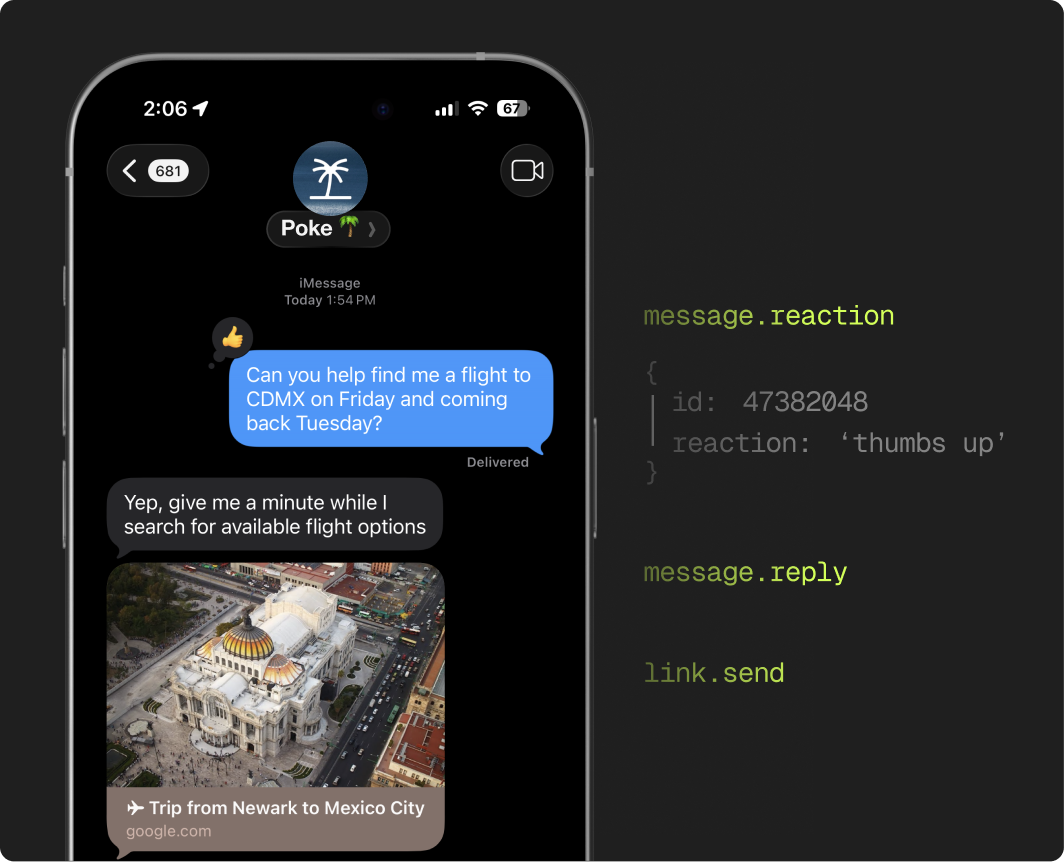
Key features include:
- Native iMessage, RCS, SMS, and Voice: Linq supports all four channels through a single API. It can use iMessage when the recipient uses an iPhone and fall back to RCS or SMS when needed, so developers don't have to build separate messaging integrations for each channel.
- Sub-120ms latency: Linq can send messages in under 120 milliseconds. Lower send latency helps agents respond faster during back-and-forth exchanges, especially when users send several messages in a short period.
- 99.95% uptime with a contractual SLA: Linq offers 99.95% uptime backed by a contractual SLA. For businesses using agents for customer support, sales, scheduling, or other ongoing interactions, this guarantees that those conversations continue without interruption.
- Flat per-number pricing: Instead of charging you for every single outbound and inbound text, Linq charges a flat fee per phone number. This means your agent can exchange multiple messages with the same user without costs increasing with each response.
- The only SOC 2 Type II–certified iMessage API: Linq is the only iMessage API on the market with SOC 2 Type II certification. Message data is encrypted and inaccessible even to Linq itself.
These features make Linq especially useful for companies that want AI agents to hold ongoing, secure, two-way conversations with users.
Linq handles the messaging infrastructure, so teams can send and receive messages without managing their own Macs, using personal Apple IDs, or self-hosting servers.
Pricing: Linq has a free sandbox you can use to test your messaging workflows. When you're ready to upgrade, talk to an expert for a custom quote.
Read: iMessage for Agents: How to Integrate iMessage for AI agents
6 other messaging APIs for agent builders
Linq is our top overall pick, but it's not the only option worth considering. Here are six other messaging APIs for agent builders and what each one offers.
2. Sendblue
Sendblue is a well-established business messaging platform and API that lets companies send and receive blue-bubble iMessages, RCS, and SMS texts from dedicated phone numbers through a CRM or software application.
It helps teams execute customer communication workflows, including sales outreach, support, notifications, and conversational messaging.
Key features of Sendblue
- Two-way webhooks: Sendblue pushes user replies back to your server in real time so your AI agent can read and process incoming messages and reply.
- iMessage, RCS, and SMS/MMS: Sendblue supports iMessage and SMS/MMS, plus RCS on its newer V2 lines. It can automatically choose the appropriate service and fall back to SMS when RCS delivery fails.
- Rich messaging features: The API supports rich media, read receipts, typing indicators, reactions, contact sharing, and group messaging. These features give developers more control over how conversations appear and behave inside Messages.
- CRM and workflow automation: Sendblue connects with tools like HubSpot, Salesforce, Close, and Zapier to trigger automated welcome texts, appointment reminders, and follow-ups based on customer behavior.
Pricing: Sendblue offers a free sandbox for testing. Its AI Agent plan costs $100/month per dedicated line for up to 1,000 inbound contacts per day. Enterprise pricing is custom.
3. Blooio
Blooio is a newer entrant in the messaging API space, which means it has a shallower track record compared to veterans like Sendblue. However, it stands out for its incredibly fast, self-serve onboarding that eliminates the bureaucratic red tape.
Since you don't need a DUNS number, business verification, or an Apple ID to get started, you can set up and send your first message in just a few minutes.
Key features of Blooio
- Multi-channel fallback routing: Blooio routes text communications as an iMessage first. If the recipient doesn't use an iPhone, it automatically down-routes the message using RCS or standard SMS/MMS.
- Native iMessage features: It supports interactive Apple elements like real-time typing indicators ("is typing..."), group chats, and digital media, including images, video, audio clips, and contact vCards.
- Hybrid mode: Blooio can start a conversation over Twilio SMS, then switch future messages to iMessage after the recipient replies. This gives teams an easier way to move engaged users into richer iMessage conversations.
- Hosted MCP server and native integrations: Blooio offers a hosted MCP server that lets developers connect AI agents like Claude and ChatGPT to messaging. Blooio also integrates with tools like n8n, Make, Zapier, HubSpot, GoHighLevel, and the Vercel Chat SDK, which gives developers several ways to add messaging without working directly with the REST API.
- Deliverability monitoring: Blooio tracks sending patterns such as volume, reply rates, bursts, and message similarity to flag numbers that may be at risk of filtering or suspension.
Pricing: Blooio offers a free trial that allows you to send 20 free messages. Paid plans start at $39/month, with shared and dedicated options available.
4. Loop Message
Loop Message is a robust messaging API designed for teams that need deep, fine-grained control over their communication infrastructure. It supports iMessage, RCS, SMS, and WhatsApp, and integrates smoothly with AI assistants.
However, getting started takes some work. Onboarding requires you to provide a DUNS number, complete formal business verification, and configure your own Apple ID.
You also can't send thousands of messages on day one. You must progressively "warm up" new lines, starting small and gradually scaling up to handle higher volumes.
Key features of Loop Message
- Unified omnichannel messaging: Use one phone number and a single API to seamlessly deliver iMessages, RCS, SMS, or WhatsApp texts to your customers.
- Rich media & two-way messaging: Loop Message allows AI agents to send and receive rich media, such as files, images, text, and voice messages directly within conversation threads.
- Sender pools: You can group several sender numbers into one pool. Loop Message distributes new users across them while keeping existing conversations connected to the same sender.
- Deferred messages: If a message hits a sending interval, Loop Message can queue it and send it as soon as your rate limits allow. This saves you from building your own scheduling and retry logic.
Pricing: Loop Message has a free sandbox that lets you send unlimited messages to 5 contacts (dedicated sender). Shared sender plans start at $20/month, while dedicated sender plans start at $59.99/month for up to 300 active daily contacts.
5. Twilio
Twilio is a long-standing legacy texting API that offers global SMS and voice coverage, mature documentation, SDKs, and extensive carrier support. However, it was built as a general communications platform rather than specifically for AI agents.
Twilio doesn't natively support iMessage, so to send blue-bubble iMessages, you need to pair Twilio with an iMessage API like Linq or Blooio and route messages between the two providers.
Key features of Twilio
- Programmable messaging: Twilio allows software apps to programmatically send and receive high-volume text messages, rich media, and automated alerts via SMS, MMS, and WhatsApp.
- Global SMS and voice reach: The platform can send texts and route calls across a large international carrier network, making it a strong option for companies operating across multiple countries.
- Twilio Flex (Cloud Contact Center): Twilio offers a fully customizable digital contact center platform that allows you to manage sales or customer support teams across chat, voice, email, and video in a single agent interface.
- A2P 10DLC compliance automation: It has built-in registration tools to automatically verify businesses and messaging campaigns with US mobile carriers. This prevents automated texts from being blocked as spam.
Pricing: Twilio offers a free trial. It also uses metered per-message pricing. In the U.S., SMS and RCS plans start at $0.0083 per inbound or outbound message. Prices vary depending on the service you require.
6. Vonage
Vonage is another legacy texting API that provides global carrier infrastructure for business communication. Its Messages API lets teams manage SMS, MMS, RCS, WhatsApp, Viber, and Facebook Messenger through one integration.
Like Twilio, however, Vonage lacks native iMessage support, meaning you cannot send blue-bubble texts through its platform without integrating a separate iMessage API.
Key features of Vonage
- Broad carrier reach: Vonage connects to more than 1,600 carriers worldwide, making it well-suited to companies that need to send messages across many countries and mobile networks.
- Programmable voice & IVR: This platform allows software applications to make, receive, and route automated phone calls globally, build interactive voice menus (IVR), track call analytics, and deploy text-to-speech or voice-recognition tools.
- 99.99% platform uptime: Vonage maintains a highly stable, enterprise-grade architecture backed by a published 99.99% uptime SLA.
- Built-in messaging compliance: Vonage automates parts of carrier compliance, including sender IDs and message concatenation, which reduces some of the work involved in operating SMS across different markets.
Pricing: Vonage uses usage-based, metered pricing that varies by country and channel. U.S. SMS pricing starts at $0.00860 per message, while other channels have their own per-message rates and carrier fees.
7. Plivo
Plivo is a traditional, developer-focused communications API built mainly for high-volume business messaging use cases like alerts, notifications, one-time passwords (OTPs), and marketing campaigns.
Its Messaging API supports SMS, MMS, RCS, and WhatsApp, but not iMessage.
Plivo also offers tools for building and deploying voice AI agents, although its text messaging products are still geared more toward transactional and campaign messaging than agent-led, back-and-forth conversations.
Key features of Plivo
- Global messaging: Plivo allows applications to programmatically send and receive text messages, transactional alerts, and multimedia (MMS) notifications globally across 190+ countries.
- 99.99% uptime: Plivo publishes 99.99% uptime for its communications platform, which helps reduce the risk of interruptions during customer interactions.
- Built-in message queuing: When traffic exceeds a number's sending limit, Plivo queues messages and sends them at the appropriate rate. This helps teams manage large campaigns without building their own rate-limiting system.
- Automatic opt-out handling: Plivo detects common opt-out responses such as
STOP,CANCEL, andUNSUBSCRIBEand handles them automatically. - SMS data redaction: Teams can prevent message content and phone numbers from appearing in Plivo's logs, which is useful when messages contain sensitive information.
Pricing: Plivo offers a metered, pay-as-you-go plan to get started. It includes $10 in free credits, and you get SIP trunking, audio streaming, voice AI agents, and phone numbers with coverage in the U.S. and India. Everything else — including SMS, WhatsApp, and Verify, and coverage beyond the U.S. and India — is available on the Enterprise plan, which starts at $1,000/month.
How to choose your go-to messaging API for AI
The right messaging API depends on what you're building and how you plan to use it. Some teams need an AI agent that can hold ongoing, two-way conversations across multiple channels, while others care more about global reach, WhatsApp support, or high-volume transactional messaging.
To make the choice easier, the table below matches common use cases with the platforms best suited to each one.
| If you are… | You need… | We recommend… |
|---|---|---|
| Deploying AI agents that need to hold two-way conversations with users | Fast bi-directional support across iMessage, RCS, SMS, and voice, plus flat-rate pricing that does not increase with every reply | Linq |
| Building an agent that also needs to communicate on WhatsApp | An API that supports iMessage, RCS, SMS, and WhatsApp, with a quick self-serve setup | Blooio |
| Looking for an established messaging API with a broad feature set | Two-way conversation support, rich messaging features, and a provider with a long track record | Sendblue |
| Managing messaging across several sender numbers and can handle a more involved setup | Dedicated senders, sender pools, opt-in forms, and support for multiple messaging channels | Loop Message |
| Already using Twilio and want to add iMessage | Twilio for global SMS/voice plus a separate API for blue-bubble messaging | Twilio + Linq or Twilio + Blooio |
| Operating globally and mainly need SMS, voice, or other mainstream channels | Mature carrier coverage, enterprise tooling, and established infrastructure | Twilio or Vonage |
| Sending large volumes of OTPs, alerts, or marketing messages | High-throughput transactional messaging, queuing, sender pools, and compliance controls | Plivo, Twilio, or Vonage |
For most businesses building conversational AI over text, Linq is the strongest overall choice because it provides two-way messaging, native iMessage, RCS, SMS, and voice support, rich media support, low latency, 99.95% uptime, managed infrastructure, and flat per-number pricing.
The other platforms become stronger options when a specific requirement — such as WhatsApp, global carrier coverage, or high-volume transactional messaging — matters more.
Get started with Linq's free sandbox
Linq's free sandbox lets you set up a messaging flow and send your first message in five minutes or less. Test the API before committing, then upgrade when you're ready for dedicated numbers, higher limits, and more functionality for agent-led conversations.