SMS is still one of the easiest ways for an AI agent to reach almost anyone. It works on every mobile phone, requires no app download, and is easy to integrate with existing tools.
But not every SMS API is well suited to an agent that needs to have ongoing, two-way conversations with users. Deliverability, latency, pricing, carrier coverage, and AI-specific tooling can vary considerably between providers.
This guide compares three of the best SMS API providers for AI agents: Twilio, Vonage, and Plivo. We'll also cover what to look for when choosing an SMS API, where SMS falls short for conversational agents, and a better iMessage-first option to consider.
What to look for in an SMS API
An SMS API allows software applications to programmatically send and receive text messages through code instead of a phone or messaging dashboard. For AI agents, it serves as the bridge between your agent and a user's mobile device.
When comparing SMS API providers, prioritize these key features:
- Deliverability and carrier reach: Check whether the provider has strong carrier coverage in the countries you need, especially if you plan to message users across the US and international markets. Better reach can reduce failed or delayed messages.
- Two-way support: If your AI agent needs to hold conversations, the API must support inbound SMS as well as outbound messages. So, make sure the provider offers real-time webhooks to route user replies back to your agent instantly.
- Pricing model: Most SMS APIs charge per message, with additional fees depending on destination, phone number type, or carrier. For conversational agents sending many back-and-forth messages, per-message pricing adds up quickly, so opt for a flat per-number pricing model instead.
- Integration effort: Speed up development by choosing a provider with a clean SDK, clear documentation, secure API key authentication, and a fast time-to-first-send (under 10 minutes).
- Reliability: Look for a published uptime Service Level Agreement (SLA) of 99.9% or higher. This matters because outages can interrupt live conversations and prevent your agent from sending or receiving messages.
Why SMS alone falls short for AI agents
SMS has one major advantage: universality. It works on virtually every mobile phone without requiring an app, account, or specific operating system. That makes it an excellent default channel and a reliable option for alerts, verification codes, and other outbound messages.
But AI agents are designed to have ongoing conversations, and that exposes several limitations of SMS:
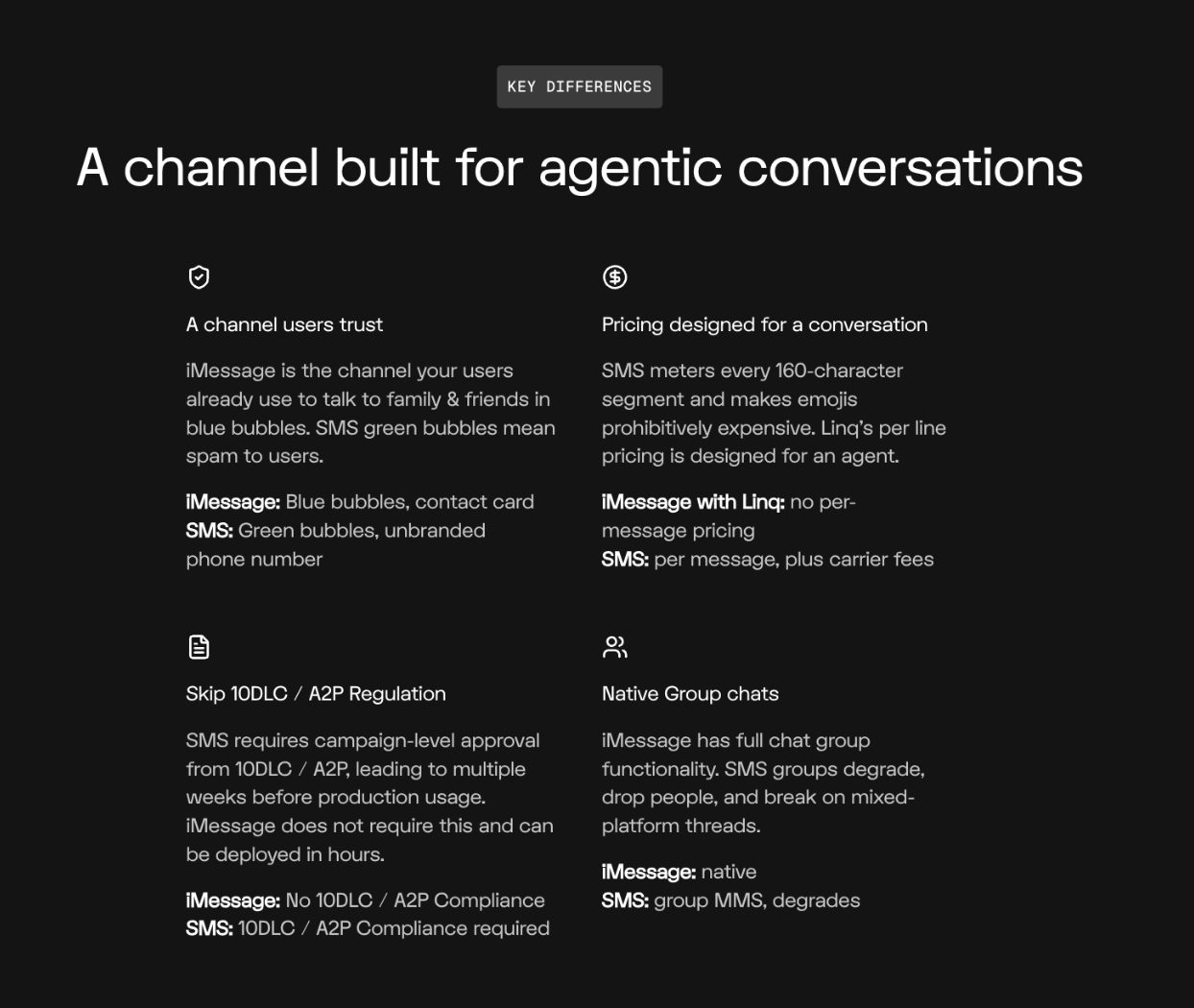
- Messages are constrained by SMS segments: Standard SMS restricts messages to rigid 160-character segments and doesn't support native rich media. So, if an AI agent drafts an exhaustive, context-rich response, it splits into multiple messages, increasing carrier costs and jumbling the user's reading order.
- Engagement can be lower than iMessage: SMS is widely used, but that reach doesn't always translate into strong response rates. Whatsnap analyzed 847,000 messages across 43 agencies and found that 54% of iMessages received a reply versus 19% of SMS messages. This shows that SMS alone isn't enough for conversational AI agents.
- SMS lacks conversational cues: Standard SMS doesn't provide native read receipts, typing indicators, reactions, or other signals users expect from iMessage and WhatsApp. As a result, even a technically two-way SMS exchange can still feel more transactional than conversational.
- Onboarding takes weeks: Sending SMS at scale in the U.S. requires 10DLC/A2P registration — brand vetting and per-campaign approval that typically takes one to four weeks before an agent can send its first production message. Every new use case has to go through that approval again, and your send volume stays capped by a carrier-assigned trust score until you do.
- SMS travels in the open: Standard SMS is unencrypted plaintext, and a message often passes through three or more carriers on its way to the recipient. For agents handling anything sensitive, that's a meaningfully weaker security posture than an end-to-end encrypted channel.
- Per-message pricing adds up: SMS providers typically charge by message. An agent generating longer answers and several back-and-forth replies can therefore cost more as conversation volume grows.
A better option for AI agent builders: iMessage (with SMS fallback)
As Whatsnap's analysis shows, iMessage gets far more replies than regular SMS. One likely reason is familiarity: people tend to associate the blue iMessage bubble with personal conversations, while SMS is often used for verification codes, alerts, and promotional messages.
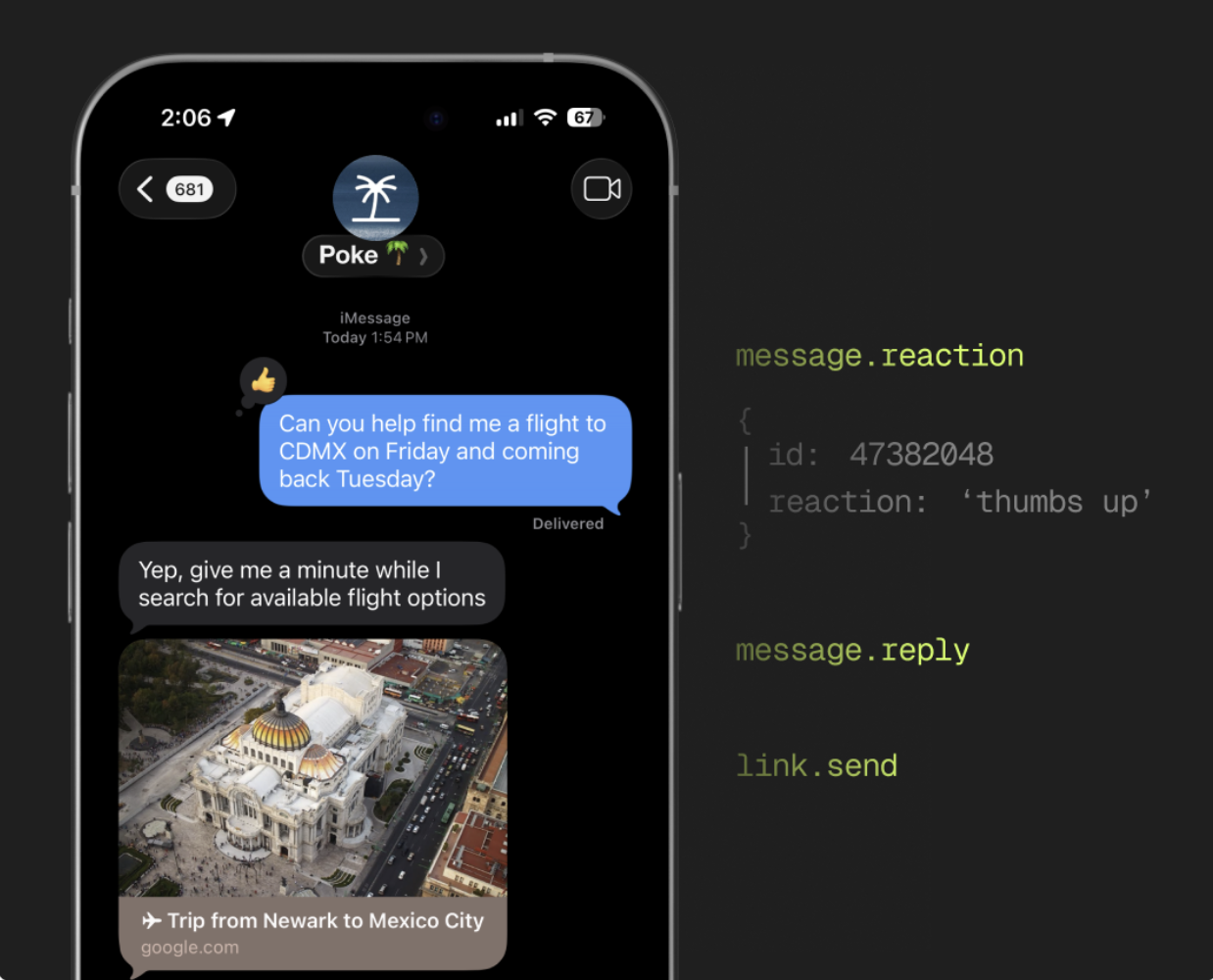
iMessage also supports typing indicators, read receipts, reactions, and other features that make conversations feel more natural. For an AI agent, that makes iMessage a stronger primary channel for ongoing conversations.
Since Apple does not offer an official iMessage API for programmatic messaging, you'll need a third-party provider. But not everyone uses an iPhone, so your iMessage API provider should also support automatic fallback to RCS and SMS.
Linq is a good example. It supports native iMessage, RCS, SMS, and Voice through a single integration and is built specifically for AI agents that need to send and receive messages.
Linq offers several agent-first capabilities:
- Sub-120ms latency: Linq processes messages in under 120 milliseconds, helping agents respond quickly and keep conversations moving.
- 99.95% uptime SLA: Linq guarantees 99.95% uptime, so agents can send and receive messages without frequent service interruptions.
- Native iMessage features: Linq supports typing indicators, read receipts, and Tapbacks, so agents can use the same interaction cues people expect from iMessage.
- Rich media support: Agents can send and receive images, videos, PDFs, voice notes, and other files instead of relying on plain text alone.
- Flat per-number pricing: Linq charges per number rather than per message, which keeps costs low and more predictable as conversations get longer.
You can evaluate iMessage APIs using the same criteria as SMS APIs: reach, two-way support, integration effort, pricing, and reliability. The difference is that iMessage handles the conversation when available, while RCS and SMS provide the fallback needed to reach everyone else.
For a full side-by-side breakdown of the two channels, see iMessage vs SMS: Which Channel Should Your AI Agent Use?
Read: How to Send and Receive iMessages Programmatically: Exploring Your Options
3 best SMS API providers to consider
If your use case does call for traditional SMS — say, OTPs, masked-number workflows, or reaching users with no data connection — here's how the three major SMS API providers stack up.
Twilio
Twilio is often the default choice for SMS APIs because of its broad carrier reach, phone number availability across more than 100 countries, and mature SDKs and documentation. Beyond SMS, Twilio also supports phone calls, WhatsApp, and specialized tools for AI agents.
Its Twilio Agent Connect (TAC) is a software toolkit that bridges your AI model (like OpenAI) and Twilio's messaging system. This gives you a unified way to connect LLM-powered agents to Twilio communication channels instead of building separate integrations for each one.
Key features of Twilio
- Intelligent sender selection: Twilio can manage pools of phone numbers and automatically choose a suitable sender based on factors such as the recipient's country and area code. Sticky Sender can also keep a user on the same phone number across later conversations, which helps maintain continuity.
- Conversation memory for AI agents: Twilio can store and retrieve customer profiles, conversation history, observations, summaries, and traits, so an agent doesn't have to treat every new SMS as an isolated interaction.
- Built-in agent tools and human handoff: TAC has built-in tools for knowledge search, memory retrieval, and escalation. When an SMS conversation needs a person, Twilio can route it through a Studio Flow while preserving the conversation context.
- Advanced opt-out management: Twilio lets teams customize opt-in, opt-out, and help keywords and responses, including country- and language-specific configurations. It also passes the opt-out event to the application through the webhook.
Pricing: Twilio offers a free trial, but it uses metered per-message pricing. In the U.S., SMS and RCS plans start at $0.0083 per inbound or outbound message. Prices vary by the service you need.
Vonage
Vonage is another established SMS API provider with strong international coverage, reaching more than 1,600 carriers worldwide. Beyond high-volume inbound and outbound SMS, Vonage also supports MMS, RCS, WhatsApp, Viber, and Facebook Messenger. This makes it easier to expand your agent's reach without rewriting your core communication code.
Vonage also offers Vonage AI Studio, a low-code/no-code platform for building virtual agents. It includes visual conversation flows, pre-built templates, API and webhook integrations, and an Agentic NLU engine for managing prompts, slots, and guardrails. This lets teams build agent workflows directly within Vonage, rather than connecting only their own external agent stack.
Key features of Vonage
- Adaptive routing: Vonage monitors carrier performance and dynamically chooses routes based on delivery and conversion data. So, if a specific carrier route experiences a slowdown or outage, Vonage instantly reroutes your AI's text through the next fastest path.
- 99.99% published uptime: Vonage publishes 99.99% platform availability, which is important for conversational agents that need the messaging infrastructure available whenever users send or expect a reply.
- Conversational webhooks: Vonage handles two-way messaging through high-speed webhooks that instantly deliver user replies to your server. Your backend app can quickly feed the user's response into your AI model and generate a rapid reply.
- Robust security and privacy controls: Vonage includes built-in compliance tools, such as automatic data redaction, which removes sensitive customer information (like credit card numbers or passwords) from the text logs before they're stored.
Pricing: Vonage uses usage-based, metered pricing that varies by country and channel. U.S. SMS pricing starts at $0.00860 per message, while other channels have their own per-message rates and carrier fees.
Plivo
Plivo offers a developer-friendly messaging API for building communication workflows across SMS, MMS, RCS, and WhatsApp. Its SMS and MMS APIs reach more than 200 countries, while its RCS offering adds richer features such as branded senders, quick replies, and interactive media.
For AI use cases, Plivo provides AI Agent Studio, which lets you build voice and messaging AI agents for bidirectional communication. You can either use streaming APIs and SDKs or its Vibe Agent builder to create complex AI agents with natural language prompts.
Key features of Plivo
- Vibe Agent Builder: Developers can create complex messaging-agent flows from natural language prompts, then review, test, and refine the generated workflow before deployment.
- Built-in knowledge bases: Agents can use internal documents and FAQs to answer questions with company-specific information instead of relying only on the underlying model.
- App and API integrations: Prebuilt integrations connect agents with tools such as HubSpot, Zendesk, Google Workspace, and Slack, while HTTP nodes support custom external services.
- Human handoff and routing: Teams can route conversations to human specialists based on skills, queues, business hours, and escalation rules.
Pricing: Plivo offers a metered, pay-as-you-go plan with $10 in free credits. It includes SIP trunking, audio streaming, voice AI agents, and phone number coverage in the U.S. and India. Access to SMS, WhatsApp, Verify, and phone number coverage outside the U.S. and India requires the Enterprise plan, which starts at $1,000 per month.
How to choose the right messaging API (SMS or iMessage)
Choosing between these options comes down to your primary use case and user base. If you need guaranteed reach to virtually every mobile phone regardless of device type, traditional SMS may be a safe bet.
However, if your AI agent needs to hold ongoing, two-way conversations, an iMessage API may be a better fit. Just make sure it includes automatic SMS and RCS fallback so you can still reach users outside the Apple ecosystem.
As you compare providers, keep our core criteria in mind. The best option is the one that gives your agent the right mix of reach, reliability, conversation quality, and cost for your specific use case.
Start building with Linq's free sandbox
Linq offers a free sandbox with a temporary number, so you can set up a messaging workflow and send your first test messages in five minutes or less. It's a quick way to see how iMessage, RCS, and SMS routing work before moving to a production setup.