By treating iMessage as their primary UI and choosing Linq for security, zero data retention, and on-demand scalability, the team behind Poke built a product that scaled entirely through word of mouth — without ever worrying about infrastructure.
The Interaction Company of California builds Poke, a consumer product that treats iMessage as its primary interface. Users don't download an app. They chat. What started as a tool for managing email inside iMessage has evolved into something much broader: a conversational AI that people use for school, daily planning, and personal support.
Founded by Felix and Marvin, two German immigrants who moved to the Bay Area to start a company, the team knew from the beginning that iMessage was the channel. The question was who to trust with the infrastructure that would make it work.
"We are treating iMessage and SMS as our first-party UI for interacting with our product. That's a space that not very many other companies work in." — Felix, Co-founder
With Linq, the team found the infrastructure partner that made that bet possible and kept pace as organic growth pushed their messaging volume through multiple orders of magnitude.
Building a product thesis around iMessage
The original idea was straightforward: build something that triggers on every email notification, summarizes the important ones, and lets users act on them without opening an email client. But the team quickly realized people didn't want another email interface. They wanted to interact with email inside the messaging app they already used a hundred times a day.
Samyok, a Member of Technical Staff at the company, joined after interning at Robinhood and Jane Street. He'd been trying to figure out what to do after his last semester when he saw Poke's product thesis in action.
"When I saw this opportunity, I saw that this product thesis actually works. I decided to join and take a bet. And so far it's paid off really well." — Samyok, Member of Technical Staff
As adoption grew, the team discovered that email was just a fraction of what people used Poke for. Users connected all sorts of services. They used it for school. They used it to chat when they had problems. The product had taken on a life of its own.

A waitlist that felt like the product
When it came time to launch, the team faced a constraint: high inference costs meant they had to restrict access. But they didn't want a simple waitlist. Instead, they built something that lived inside the same channel as the product itself.
Users chatted with Poke's bot in iMessage, tried to convince it to give them access, and simultaneously haggled for a good price. The waitlist wasn't a gate. It was a preview of the entire product experience.
Finding a provider that checked every box
Treating iMessage as a primary UI meant the messaging provider wasn't just infrastructure. It was the product. The team's evaluation criteria reflected that. Functionality came first, then security, then price. They needed SOC 2 compliance, zero data retention, and a provider they could trust.
They searched extensively. Other providers surfaced, but none met the full requirements. Some lacked SOC 2. Others couldn't support zero data retention. Some were significantly more expensive.
"We did a ton of searching, and we only found Linq to be able to fit all three of these criteria."
The stakes were made viscerally clear before the team even found Linq. While using a previous messaging provider, Poke's messages were flagged as spam. The provider blocked all of Poke's messages for every user, on the day the company closed its fundraise. The experience underscored why the right provider wasn't optional. It was existential.
Going live with Linq, and building together
Implementation was fast. The team added Linq as a provider with minimal lift, and the first phone line was up and running quickly. But what made the relationship distinctive was what came after onboarding.
Linq built zero data retention specifically for the team, and maintained a tight feedback loop, shipping features in direct response to requests. When someone casually mentioned a Find My location feature, Linq had it done within a week.
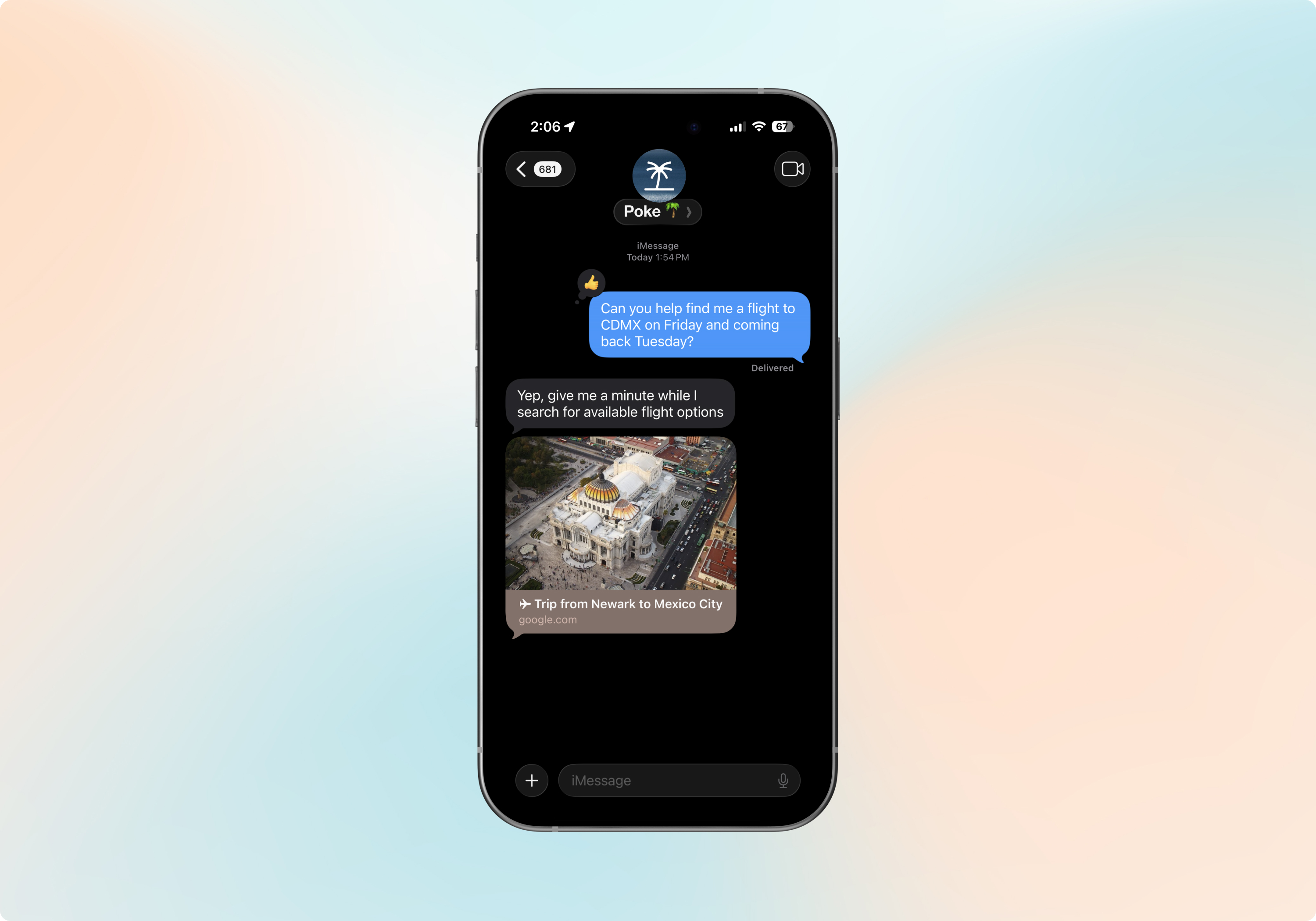
Scaling through word of mouth, without worrying about infrastructure
The team started in April with a single phone line and a small test group. Growth came in waves: first one line, then around twenty, then hundreds right before launch. Every expansion was driven by organic demand.
Within days of joining the Linq platform, the team was processing ten thousand messages in a single day. From their perspective, the experience was seamless. "It feels like a cloud provider," they say. "We can request a large number of numbers, and you guys just accommodate everything and get it done within a couple of days."
Launch night
For Felix, the most memorable moment of the past year was launch night. The team pulled an all-nighter. It was hectic. And then the next day, the numbers spiked alongside a wave of positive user feedback that the team says they'll never be able to recreate.
Infrastructure that lets a team focus on what matters
The team has scaled through multiple orders of magnitude since joining Linq. Instead of planning around infrastructure constraints, the team focuses on product and growth: expanding use cases beyond email and building new interaction models.
"It feels like a cloud provider. Every time we put in a new order for more capacity, Linq just scales with us. I think there are a lot of other providers on all parts of our infrastructure that would not be able to keep up." — Felix, Co-founder, The Interaction Company of California