If you want to connect an AI agent or custom software to native iMessage, you have two options: build the integration from scratch or save yourself the time and burden with an iMessage API.
Linq's API gives you native, two-way iMessage support without requiring your team to run the hardware and account infrastructure behind it. You also get rich media support, group chats, fast delivery, flat-rate pricing, and enterprise security built in.
In this article, we'll explain why Linq is the best iMessage API and why companies like Lindy chose us after trying to build the infrastructure themselves.
Key takeaways
- Linq provides the infrastructure developers need to build and deploy AI agents and custom applications in iMessage without managing Macs, iPhones, Apple accounts, or message-routing hardware.
- It is the only enterprise-grade iMessage API with SOC 2 Type II compliance, helping businesses protect sensitive customer information and conversations, and giving them the documentation they need to pass security, legal, and procurement reviews.
- Linq supports two-way messaging, rich media (images, videos, audio, and attachments), group chats, Tapbacks, typing indicators, and threaded replies.
- Messages are delivered with P95 latency below 120 milliseconds and backed by a contractual 99.95% uptime SLA.
- Our flat-rate line pricing keeps costs predictable, while the free sandbox lets developers test the full messaging flow before upgrading to a paid plan.
What makes an iMessage API "the best"?
Beyond sending blue-bubble messages, the best iMessage API should support the speed, context, and message volume required by AI agents, customer support platforms, CRMs, sales tools, and other products built around ongoing conversations.
Some criteria the API should meet include:
- Ultra-low latency: Messages need to be sent and received quickly enough for the conversation to feel natural, even when the agent is generating a response in real time.
- Rich media support: In addition to text, the API should also be able to process and send high-resolution images, video, and audio files (voice notes).
- Interactive features: The API should support iMessage-specific UI elements such as Tapbacks (reactions), inline replies, typing indicators, and thread management, so the agent doesn't lose context in active conversations.
- Reliable delivery and routing: The provider should handle queues, retries, delivery events, number capacity, traffic balancing, and failover without your team having to manage each device or account. It should also offer clear uptime guarantees, detailed delivery logs, and useful error messages so your team can quickly diagnose failed or delayed messages.
- Compliance and security: The API should protect message data with encryption, signed webhooks, strict access controls, and independently verified security standards. It should also provide enterprise teams with clear policies around data handling, retention, and internal access.
- Fast setup: Developers should be able to easily get API keys, test in a sandbox, configure webhooks, and send a first message without provisioning Mac Minis, iPhones, or Apple accounts.
- Sensible pricing: AI agents often generate long, back-and-forth conversations, so the API should offer flat-rate or volume-based pricing to keep costs predictable, rather than per-message carrier fees that increase with usage.
What makes Linq the best iMessage API?
What sets Linq apart from standard iMessage gateways is that our entire technical architecture was intentionally built for the AI era and for products that depend on fast, two-way communication.
Traditional SMS APIs, like Twilio, were built for one-way mass-notification blasts & sending verification codes, but Linq supports ongoing, two-way exchanges between users and the products, teams, or AI agents that serve them.
Here's what makes Linq the best iMessage API:
Reliability at scale
Building an iMessage integration yourself means taking responsibility for far more than the API layer. You also need physical Macs, paired iPhones, Apple accounts, custom bridge software, monitoring, message routing, and a plan for when any part of that setup fails.
Lindy wrote about their experience building iMessage integration themselves. Its original iMessage infrastructure ran on a Mac Mini in a Las Vegas data center, paired with an iPhone and powered by a custom Swift daemon that monitored the Messages database and sent messages through Apple's private frameworks. The bridge worked, but only one engineer knew Swift well enough to maintain it.
The team then rebuilt the system with BlueBubbles so more engineers could debug it in JavaScript. That made the code easier to support, but it did nothing to remove the hardware burden. Every phone number still needed its own Mac Mini, iPhone, and Apple account.
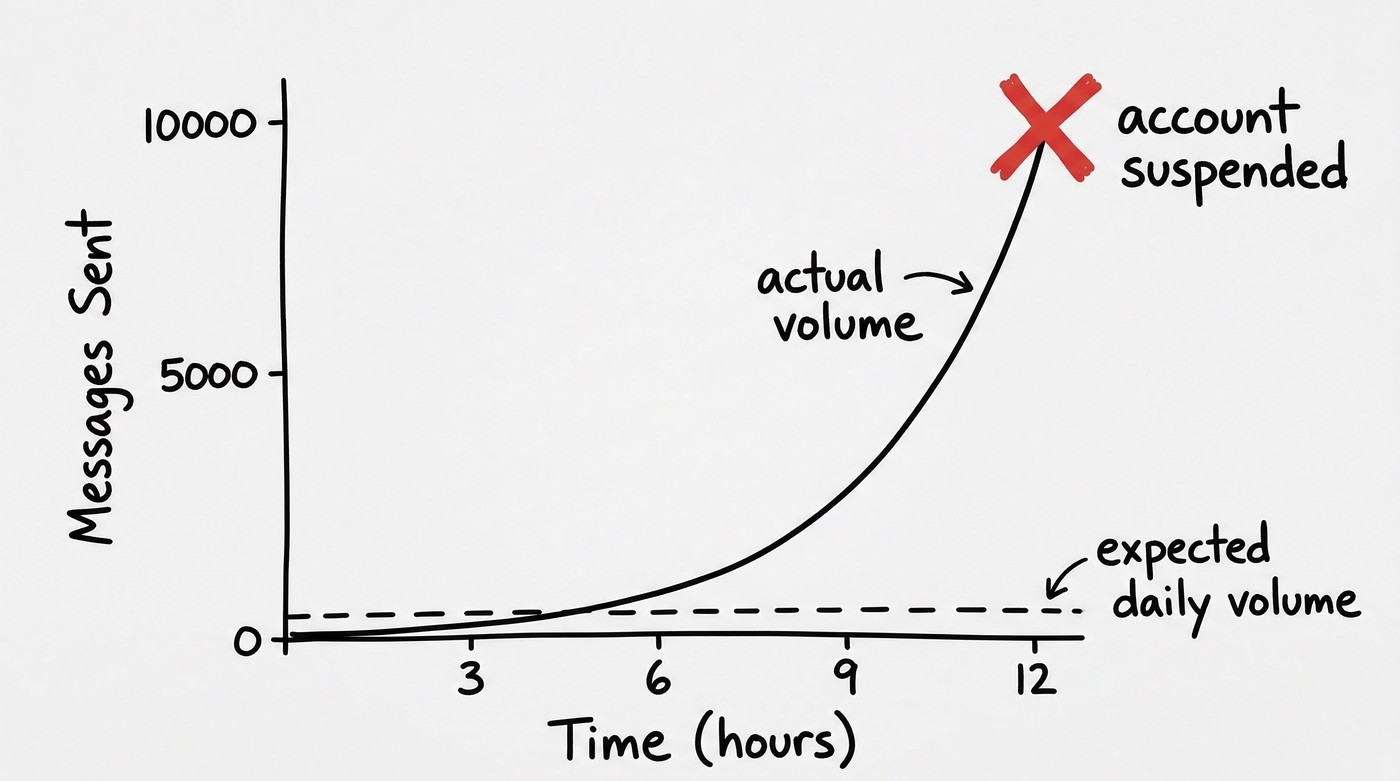
On launch day, usage surged, and Apple permanently banned the account.
Buying another device stack would only restart the same cycle, so for their third rebuild in four weeks, Lindy's team turned to an iMessage API: Linq.
Instead of provisioning more hardware and hoping the next account lasted longer, Lindy replaced the bridge with a REST API. The initial rebuild took four hours, and the full migration took a few days. Soon after, the team was able to delete 76 files and thousands of lines of bridge code because Linq now handled the hardware, accounts, routing, and anti-spam controls for them.
Complete compliance as the only SOC 2 Type II iMessage API
Apple doesn't provide a public business API for iMessage, so automated messaging can trigger its internal spam controls and lead to sudden account suspensions. Lindy experienced this firsthand when a surge in launch-day traffic led to a permanent ban.
That risk makes strong security and operational controls essential for any production deployment.
Linq is the only enterprise-grade iMessage API provider with SOC 2 Type II compliance. This provides procurement, legal, and security teams with independent evidence that Linq adheres to established controls for protecting data, managing access, maintaining system availability, and responding to security incidents.
These protections are especially important when customers share phone numbers, email addresses, attachments, account details, or other sensitive information with you via iMessage. Linq also provides the documentation your team needs to pass vendor security reviews, meet customer requirements, and get approval from internal stakeholders before launch.
Reciprocity that feels human with ultra-low latency
Unlike a notification tool that only sends information out, an AI agent also needs to understand replies, respond in context, and keep the conversation flowing.
Linq is built for that kind of two-way communication. When a user sends a text, an attachment, an inline reply, or a Tapback reaction, Linq routes the event to your server through event-based webhooks. Your application can then pass the message and its context to the AI model you use, such as GPT or Claude, generate a response, and send it back into the same conversation.
The exchange happens quickly. Once your agent finishes generating its reply, Linq delivers the message with P95 latency below 120 milliseconds, allowing replies to reach the user almost immediately after they're generated.
This back-and-forth extends beyond text. With Linq, your agent can send and receive images, videos, documents, audio files, and voice memos. It can also use typing indicators, read receipts, reactions, and threaded replies to make each conversation feel natural and easy to follow.
You are up and live in minutes, not months
Building an iMessage integration yourself can take weeks because you have to provision hardware, pair devices, manage Apple accounts, write the bridge, and test every part of the message flow.
With Linq, you can send and receive your first iMessage in less than five minutes using a test number, like your own iPhone. Once the basic loop works, an experienced developer can connect the line to OpenAI, Anthropic, LangChain, or another AI stack in about 20 to 30 minutes.
Linq also eliminates the registration delays associated with traditional business texting. A2P 10DLC approval often takes three to four weeks, but Linq can provision a production-ready enterprise number as soon as your commercial agreement is finalized.
For teams migrating an existing build, the process takes longer but still moves quickly. Lindy completed its full migration to Linq in a few days, and most similar migrations can be finished in less than a week.
Read: Getting started with Linq's sandbox
Fair and predictable iMessage API pricing
Per-message pricing can add up quickly, especially when an AI agent or customer-facing product is handling thousands of customer conversations at once. A single support thread or brainstorming session can easily reach 50–100 messages, and traditional pay-per-message APIs charge for each one.
Linq takes a different approach. We charge a flat subscription fee per active phone number, which keeps your monthly costs predictable as usage grows. Your agent/product can hold long conversations, send multi-paragraph replies, exchange rich media, and process millions of texts without every additional message increasing your bill.
Developers can also test the full experience before paying. Linq offers a free sandbox where your team can build and test two-way messaging loops, webhooks, and responses before moving to a business number.
Is Linq the best iMessage API for you?
Linq is designed for teams that want to integrate an AI agent, support platform, or other custom software with native iMessage without operating the device, account, and delivery infrastructure themselves.
You're likely a fit if:
- You need a product or team that can hold ongoing conversations with users. Linq works for AI agents, customer support teams, sales platforms, scheduling tools, and other products that rely on fast, two-way messaging. It supports rich media, Tapback reactions, typing indicators, read receipts, and threaded replies.
- You want to launch without running your own iMessage hardware stack. Linq manages the Macs, phones, Apple accounts, monitoring, and message delivery behind the API.
- You need enterprise security and reliability. Linq offers SOC 2 Type II compliance, encrypted message data, ultra-low latency, and a contractual 99.95% uptime SLA.
- You expect usage to grow. Our flat-rate pricing per active number makes it easier to forecast costs as conversations get longer and message volume increases.
- You already have an iMessage integration, but no longer want to maintain the infrastructure behind it. You can keep your agent logic and product workflows while Linq handles routing, delivery, account management, and anti-spam operations.
Build a Better iMessage Experience With Linq
You can build an iMessage integration yourself, but doing so means taking responsibility for the hardware, Apple accounts, routing, delivery, compliance, and ongoing maintenance behind every message. Running all of that in-house is expensive and gives your team more infrastructure to monitor, troubleshoot, and maintain.
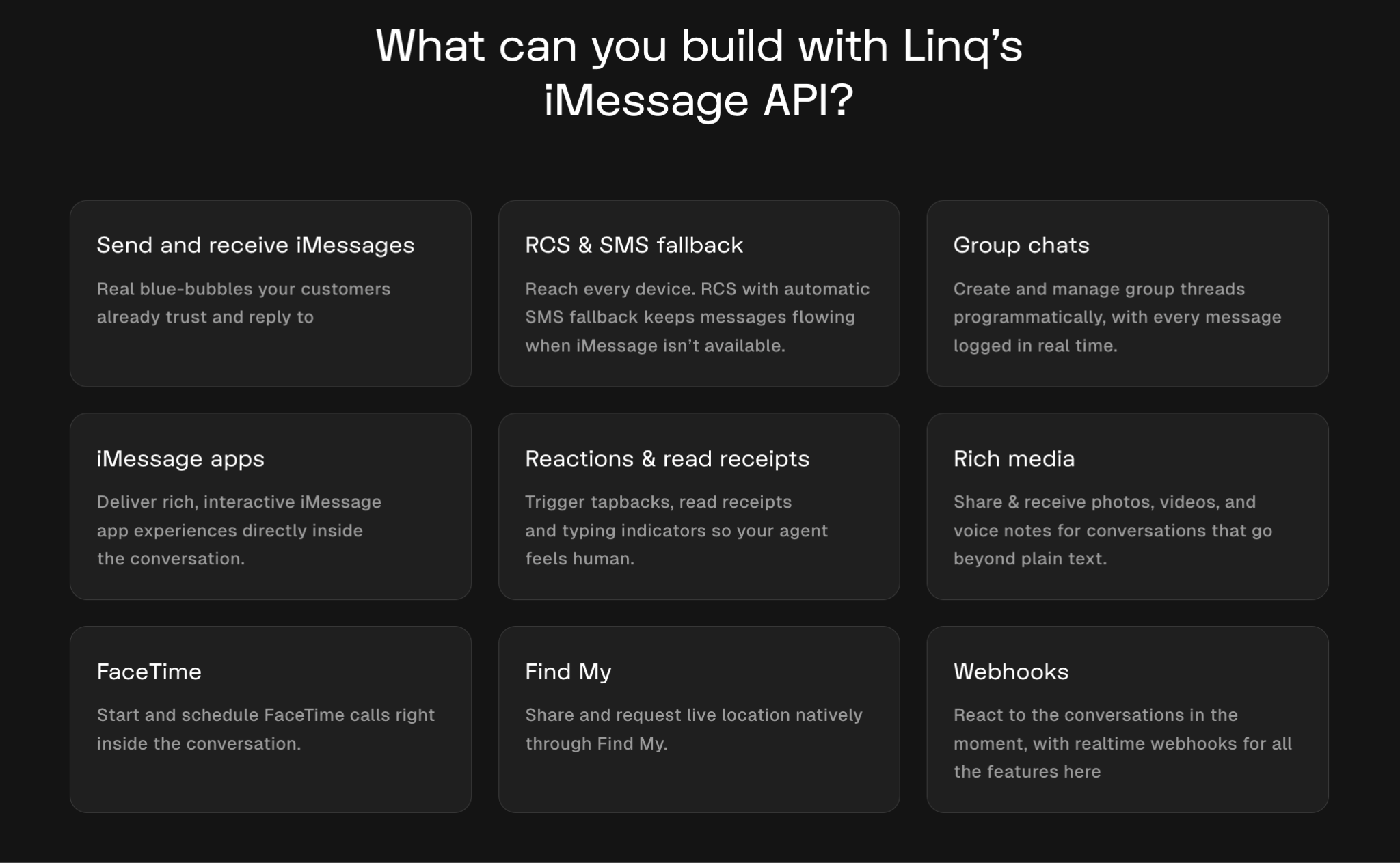
With Linq, however, you get a managed API that handles two-way messaging, with rich media support, low-latency delivery, predictable pricing, and SOC 2 Type II compliance. This leaves your engineers free to focus on improving the product, refining its workflows, and creating a better user experience.
Ready to see how it works? Set up your iMessage integration in Linq's sandbox for free.
FAQs
Is there a free iMessage API?
Yes. Linq offers a free sandbox where developers can test two-way iMessage workflows before upgrading to a paid plan. You can send and receive messages, configure webhooks, and connect your application or AI model using a temporary test number. This allows you to validate the full message flow before paying for a live, provisioned phone line.
What's the difference between an iMessage API and SMS API?
An iMessage API works within Apple's closed messaging ecosystem, allowing AI agents and custom applications to send native blue-bubble messages to users. It also supports rich media, including images, videos, audio files, and voice notes, as well as iMessage-specific features like Tapbacks, typing indicators, group chats, inline replies, and interactive apps.
An SMS API, on the other hand, sends green-bubble messages over mobile carrier networks. It works across a wider range of devices, but it's generally limited to basic text and static media and does not support the same real-time interactive features.
Can Linq replace a self-built iMessage integration?
Yes. Linq can replace the hardware and account infrastructure behind a self-built iMessage integration without requiring you to rebuild your AI agent or product workflows. Instead of maintaining Macs, phones, Apple accounts, routing, monitoring, and account health yourself, your team connects to Linq through a REST API and webhooks. And Linq handles the rest for you.
Does Linq support group chats and rich media?
Yes. Linq supports group chats and rich media, including images, videos, documents, audio files, and voice notes. Your application can receive these through webhooks, pass them to an AI model or another backend system for processing, and send media back into the same thread.
Linq also supports Tapbacks, inline replies, typing indicators, and read receipts, so the agent can keep track of context and respond appropriately in active chats.
How fast can I get an iMessage API live?
Deployment time depends on the API, your existing stack, and whether you're starting from scratch or migrating an existing build.
With Linq's sandbox, you can start sending and receiving test iMessages in less than five minutes. An experienced developer can usually connect the messaging flow to an LLM, support platform, or backend workflow in 20–30 minutes, while production provisioning and larger migrations can take a few days (but are generally concluded in less than a week).