Traditional texting APIs were built for one-way notifications—like verification codes, appointment reminders, delivery updates, and marketing messages.
However, AI agents need APIs that facilitate dynamic, two-way conversations with users. That means being able to receive messages, respond quickly, maintain context, and exchange rich media without relying on a human operator. The underlying infrastructure should also provide reliable routing, enterprise-grade security, and support for continuous back-and-forth messaging.
This buyer's guide breaks down the three main types of texting APIs available today, how each category works, and what to consider when choosing a texting API for your AI agent.
What is a texting API?
A texting API is a software interface that lets an application send and receive text messages automatically. Instead of relying on a person to use a phone, the application connects to a messaging provider via code. It can then send messages, receive replies, track delivery status, and handle media or attachments where supported.
Depending on the provider, a texting API may support SMS, MMS, iMessage, RCS, or several channels at once. This allows autonomous systems to send instant alerts, answer customer queries, and manage two-way conversations at scale without human intervention.
Why a business would need a commercial texting API
When a business needs to communicate with users at scale, a commercial texting API makes it possible. Without it, they would struggle to manually reply to dozens, hundreds, maybe even thousands of conversations.
A business may need a commercial texting API to:
- Automate two-way conversations. A texting API lets an AI agent or application send messages, understand replies, and continue the conversation without human input.
- Reach users on familiar channels. Businesses can communicate through SMS, MMS, iMessage, RCS, or other supported channels without requiring users to download a separate app.
- Handle higher message volumes. Programmable infrastructure can process far more conversations than a team using physical phones or manual messaging tools.
- Track message delivery. Delivery receipts and error updates help your application confirm whether a message arrived and respond when something goes wrong.
- Support richer interactions. Depending on the channel, your application can send images, videos, links, documents, and other rich media alongside text.
- Connect conversations to business systems. Messages can trigger actions such as scheduling an appointment, updating an account, checking an order, or creating a support request.
- Improve reliability and oversight. Commercial texting APIs provide delivery monitoring, security controls, compliance support, and infrastructure maintenance that would otherwise need to be handled in-house.
The three types of texting APIs in 2026
Texting APIs generally fall into three categories, based on how they handle messaging and conversations. Understanding what they are can help you choose the right category and then the right API within it.
Legacy SMS/CPaaS APIs
Legacy Communications Platform as a Service (CPaaS) providers are infrastructure-heavy solutions built by traditional telecommunication vendors.
These platforms were engineered for high-volume, one-way broadcasting rather than fluid, two-way conversations. This makes them a great choice for simple notification use cases, like one-time passwords, account alerts, appointment reminders, delivery updates, and marketing campaigns.
Key characteristics include:
- Broad carrier access. They let applications and AI agents send SMS and MMS to users across different mobile networks and countries.
- Carrier-based pricing. Costs may include per-message fees, message segment charges, phone number fees, and carrier surcharges, which make pricing harder to predict.
- Registration requirements. Businesses sending application-to-person (A2P) messages to US numbers may need to complete A2P 10DLC registration (which can take weeks) and comply with carrier rules.
- No native iMessage support. These platforms can send SMS and MMS, but they don't support native iMessage features such as blue bubbles, read receipts, and richer media.
- Limited agent infrastructure. The API handles message delivery, but your team still needs to build logic to track conversation history, verify user identities, route messages, and trigger agent workflows.
iMessage point solutions
iMessage point solutions are specialist providers that layer iMessage capabilities on top of infrastructure originally built for outbound business texting.
They help sales and marketing teams bypass spam filters and low open rates associated with traditional SMS by delivering branded, blue-bubble messages directly to Apple users.
Key characteristics include:
- Support for richer interactions. Depending on the provider, these platforms may support rich media, including images, videos, and documents, as well as interactive features like read receipts, typing indicators, and reactions.
- A strong focus on outreach workflows. Many iMessage point solutions were built around outbound use cases such as sales follow-ups, lead nurturing, CRM outreach, and notifications.
- Two-way messaging through webhooks. Applications can receive replies and continue conversations, but your team may still need to build logic to maintain context, coordinate agent actions, and manage complex conversation flows.
- Limited support for agent-led conversations. These platforms make it easier to reach iPhone users via iMessage, but they lack the infrastructure to sustain back-and-forth conversations between AI agents and users.
Agent-native messaging infrastructure
Agent-native messaging infrastructure is the most sophisticated texting API. It's built for applications and AI agents that need to hold continuous, two-way conversations with users.
Reciprocity (the ability to send and receive messages) is a part of the architecture from the start, rather than a feature tacked onto a system designed for one-way notifications or outbound outreach.
A great example of this type of texting API is Linq.
Key characteristics include:
- Two-way messaging by design. The infrastructure supports sustained back-and-forth exchanges, allowing agents to receive messages, respond quickly, and follow conversation context over time.
- Built around agent workflows. When a user sends a message, the API delivers it to your server through a webhook. The server then passes the message to an LLM, such as GPT or Claude, and sends the agent's response back via the messaging API.
- Native support for richer messaging. The infrastructure supports channels like iMessage, RCS, and SMS, as well as rich media, typing indicators, group chats, read receipts, Tapback reactions, and message threading.
- Low-latency delivery. Agent-native texting APIs like Linq process messages extremely quickly, helping agents respond at the pace of a natural conversation.
- Built-in reliability and routing. The platform selects healthy sending numbers, routes around delivery issues, reuses existing conversations, and handles failover without requiring your team to build that logic from scratch.
- Secure messaging infrastructure. Encryption, access controls, and compliance safeguards help protect sensitive user information and reduce security risks.
- No per-message pricing. Agent-native texting APIs often use flat or usage-based pricing rather than per-message pricing. This makes costs easier to predict as conversation volume increases.
The 10 best texting API options for your business
We compared ten of the top texting APIs against the features that matter most for AI agents. Here's how they stack up:
| Two-way support | iMessage | SOC 2 Type II Certified | Contractual uptime SLA | Flat pricing | Test sandbox (setup time) | |
|---|---|---|---|---|---|---|
| 1. Linq | Yes | Yes | Yes (and the only SOC 2 Type II–certified for iMessage API) | Yes (99.95%) | Yes (fee per active number) | Yes (~5 min) |
| 2. Twilio | Yes (SMS/RCS) | No | Yes | Yes (99.95%) | No | Yes (free trial) |
| 3. Vonage | Yes | No | Yes (Network APIs) | Yes (99.99%) | No | Yes |
| 4. Bird (MessageBird) | Yes (SMS, omnichannel) | No | Yes | Yes (99.95%) | No | Yes |
| 5. Plivo | Yes | No | Yes | Yes (99.99%) | No | Yes (free trial) |
| 6. Telnyx | Yes | No | Yes | No | No | Yes (free trial) |
| 7. Infobip | Yes | No | Yes | Enterprise contracts only | No (custom/negotiated) | Yes (60-day trial) |
| 8. Sinch | Yes | No | Yes | Yes (99.95%) | No | Yes (free trial) |
| 9. Bandwidth | Yes | No | Not publicly stated | Yes (99.999%) | No | Not stated |
| 10. SignalWire | Yes | No | Yes | Yes (99.95%, 99.99% dedicated) | No | Yes |
Here's a deeper look at the tools that qualify as the best texting APIs on the market in 2026:
Linq
Linq is built specifically as agent-native infrastructure. Reciprocity (sending and receiving messages) is part of the architecture from the start. It combines native iMessage support with RCS, SMS, and Voice, backed by a 99.95% uptime SLA, under-120ms latency, and flat per-number pricing instead of metered per-message costs. For teams building AI agents that need to hold real, ongoing conversation, rather than just send outbound blasts, it's the only option in this list built around that use case from the ground up.
Twilio, Vonage, Bird, Plivo, Telnyx, Infobip, Sinch, SignalWire (Enterprise CPaaS)
These legacy texting API tools are built for OTPs, alerts, and marketing at global scale, with broad carrier reach and mature developer tooling. Most of them carry SOC 2 Type II certification, and several publish strong uptime SLAs. Vonage and Plivo sit at 99.99%, with the others around 99.95%. None of them support native iMessage, though, and pricing across the board is metered per message or negotiated at enterprise scale rather than flat, which makes costs harder to predict as an AI agent's conversation volume grows.
They're also generally architected for one-way or broadcast-style messaging rather than the sustained, context-aware two-way exchanges agent use cases need.
Bandwidth
Bandwidth runs its own Tier-1 carrier network rather than reselling access, which gives it a strong 99.999% uptime claim and direct-to-carrier reliability. It's metered per message, not flat, and unlike most others on this list, it doesn't publicly state SOC 2 Type II certification, which is worth confirming directly if compliance is a procurement requirement.
There's no native iMessage support with Bandwidth.
How to choose the right texting API for your AI agent use case
Choosing a texting API involves more than comparing messaging channels and usage fees. You also need to consider how well the platform supports two-way conversations, handles delivery issues, protects user data, and fits your development timeline.
Here's a checklist to use when comparing texting API providers:
- Reciprocity. Make sure the API supports two-way messaging, so your agent can both send messages and receive replies. It should also support rich media (images, videos, documents, and audio files), group chats, typing indicators, and read receipts without requiring your team to build those features separately.
- Reliability. Check how the provider handles failed messages, routing problems, and service interruptions. Features like automatic failover and delivery tracking reduce the work your team has to handle.
- Compliance and security. Review the provider's security standards (SOC 2 Type II, HIPAA, GDPR, etc.), encryption, access controls, data policies, and compliance certifications. Also, check whether you need to manage carrier registration or other messaging requirements yourself, or whether the platform handles them as well.
- Pricing model. Look beyond the subscription price and account for per-message fees, carrier surcharges, phone number charges, registration costs, and usage limits. Choose a pricing model that keeps costs easy to predict as your agent supports more users and longer conversations.
- Speed to launch. Your team should be able to launch two-way messaging within a week or less. So, look for platforms that have clear documentation, straightforward webhooks, useful SDKs, a reliable test environment, and managed routing to help you get things up and running quickly.
Why choose Linq as your go-to texting API?
Linq is built for teams that want to launch reliable, two-way messaging without spending months assembling the infrastructure themselves. Here's what sets it apart from other texting APIs:
- 99.95% uptime with a contractual SLA. Linq guarantees 99.95% uptime in your contract as a service-level agreement (SLA). So if you need your agent to text customers around the clock, you can count on Linq to be available.
- Under 120ms latency. Linq sends messages in under 120 milliseconds. At that speed, your agent's replies arrive fast enough for the conversation to feel natural, as if a person were on the other end of the line.
- SOC 2 Type II certified. Linq has SOC 2 Type II compliance (and is the only API provider with SOC 2 Type II compliance for iMessage), which provides your security, legal, and procurement teams with independent evidence that Linq protects user data, controls access, and follows audited procedures for handling security incidents. This helps you pass vendor reviews before launch.
- A working testing sandbox. Linq provides a sandbox where you can set up and test your messaging workflow in about five minutes. This allows you to confirm that everything works as expected before upgrading to a paid plan.
- No per-message pricing. Linq charges a flat subscription fee per active phone number rather than per message. This way, your agent can send and receive thousands of messages without inflating your monthly costs.
Companies like The Interaction Company of California use Linq to build products that meet people where they already are. Their AI assistant, Poke, started as a simple email summarizer until the team realized users wanted AI they could actually talk to, right in iMessage.
Instead of a traditional waitlist, they launched with a chatbot "bouncer" that let users negotiate their own membership price, sparking an engaged community from day one. It's a glimpse of what's possible when a texting API is built to scale with you.
"Linq feels like a cloud provider, it just scales with us. I think there are a lot of other providers on all parts of our infrastructure that would not be able to keep up." — Interaction Co. California
👉 Read: Why Lindy chose us as their iMessage API
Connect your AI agents to users with Linq
Texting APIs give businesses a programmable way to communicate with users, whether that means sending one-way alerts and verification codes or supporting ongoing, two-way conversations.
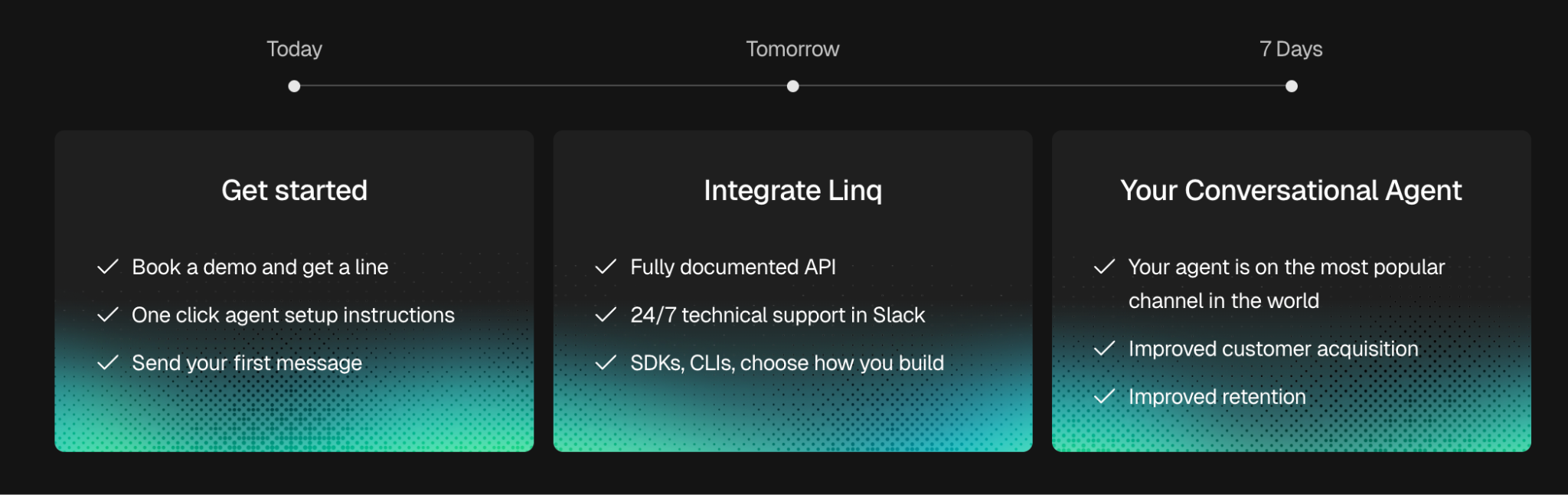
Linq is an agent-native texting API that lets you connect your AI agent to users through iMessage, RCS, and SMS. It supports incoming and outgoing messages, rich media, group chats, read receipts, typing indicators, and reactions such as Tapbacks, giving your agent the tools to communicate more naturally.
Ready to test it? Use Linq's free sandbox to set up a messaging workflow in five minutes or less.
FAQs
What's the difference between a texting API and an iMessage API?
A texting API is a software interface that lets applications and AI agents send messages, whether that's SMS, MMS, RCS, or iMessage.
An iMessage API, on the other hand, is a specific type of texting API designed to connect AI agents to Apple's native iMessage platform. These APIs include iMessage-specific features like read receipts, typing indicators, group chats, and rich media.
Is there a free texting API?
Many texting APIs give you a free sandbox where you can send test messages, set up webhooks, and confirm that your workflow works the way you expect. However, to connect a dedicated business line and let your agent communicate back and forth with users, you need a paid plan.
Do I need A2P 10DLC registration for a commercial texting API?
Yes. If you plan to send messages from a standard 10-digit phone number to US mobile numbers, A2P 10DLC registration is mandatory.
Major mobile carriers require this registration to prevent spam and verify your business identity. Failure to register results in message blocking, heavy carrier filtering, or severely restricted daily message limits.
Registration includes two primary steps:
- Brand registration. You register your company's legal details (such as an EIN/Tax ID) with a central database called The Campaign Registry. This assigns you a Trust Score.
- Campaign registration. You declare your messaging use case (e.g., marketing, appointment reminders) and define your message flows.
Approval usually takes 1–4 weeks. The exact fees and throughput limits (how many texts you can send per second) depend on your API provider (e.g., Twilio or Plivo).
But if you want to connect your agent to iMessage specifically, you can skip registration. An iMessage API like Linq runs on Apple's network instead of the carriers', so it sidesteps 10DLC entirely, which helps you launch faster.
Can a texting API support two-way AI agent conversations?
Yes, if it's built for two-way messaging. The API receives each inbound message via a webhook, passes it to your LLM, and sends the response back to the same thread.
Older SMS APIs can do this, but because they were originally built for one-way blasts, their conversational infrastructure is not as robust as that of tools like Linq, which were built with reciprocity in mind.
How much does a commercial SMS texting API cost?
Legacy vendors typically charge a small fee per message (around $0.0085), but add variable carrier surcharges that make high-volume costs unpredictable. Other platforms, like Linq, offer a flat fee per dedicated line, allowing your agent to communicate with thousands of customers without inflating your monthly bill.