The 9 best iMessage API providers in 2026
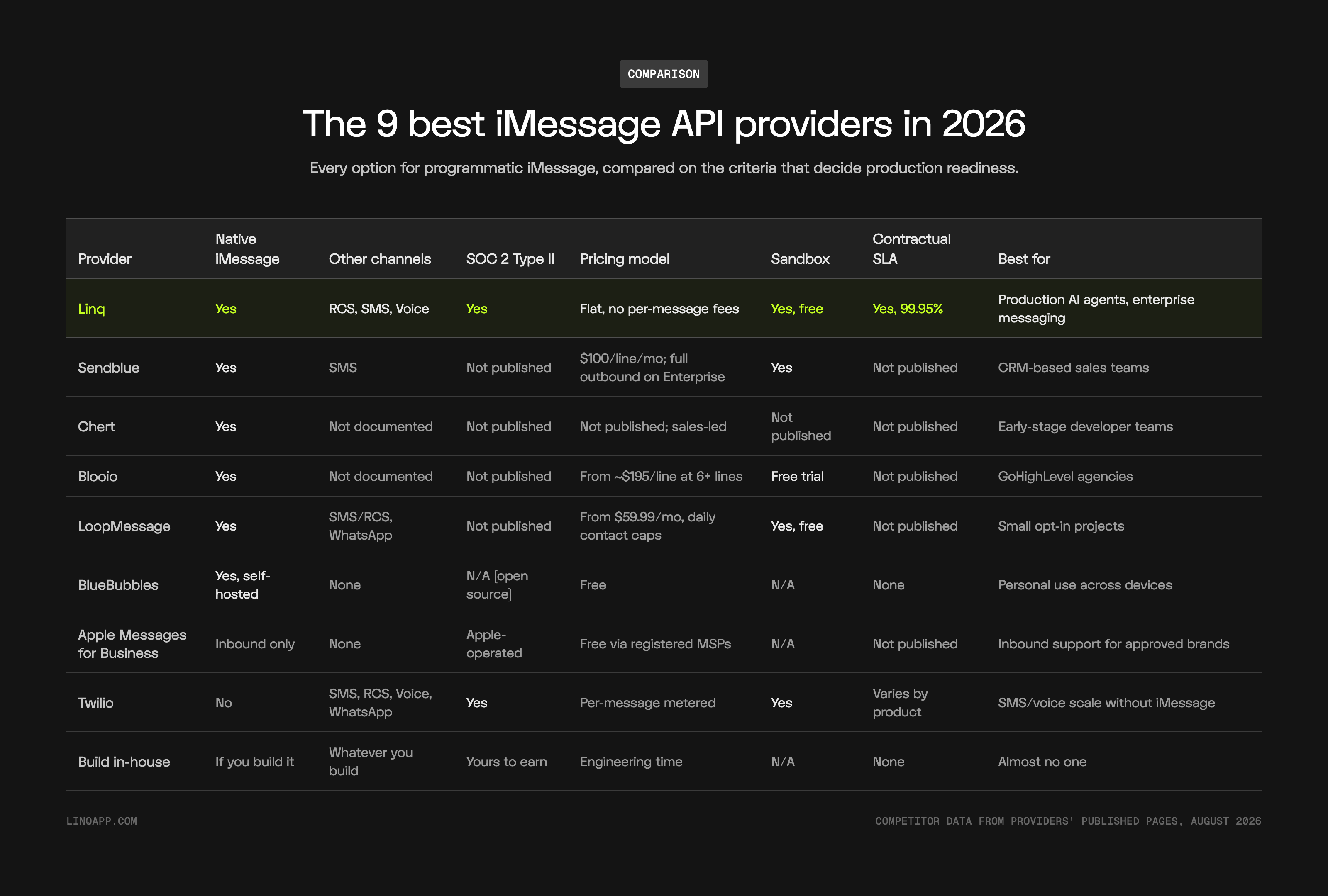
This is a complete guide comparing all nine options on the market in one table, then a short verdict on each.
The criteria
- Channel coverage. iMessage reaches iPhones; Android users need RCS or SMS from the same API. A provider that stops at iMessage forces a second vendor.
- Compliance. A SOC 2 Type II audit is a third-party attestation a security team can file, and it is rare in this category. HIPAA is a live question for healthcare buyers; published claims vary by vendor and few are backed by a named audit, so ask each vendor for documentation directly.
- Pricing model. Per-message metering was built for campaign blasts and punishes conversational traffic, especially AI agents that send many small messages per session. Flat pricing fits conversation-shaped workloads.
- Delivery guarantees. An uptime number in a contract with remedies attached is a different product from an uptime number on a marketing page.
- Outbound rules and caps. Several providers gate outbound behind higher tiers, cap daily conversations per number, or prohibit certain sends outright. These limits, always easy to miss on a pricing page, become the real ceiling on your product.
1. Linq
Best for: production AI agents and enterprise customer messaging over iMessage where reliability, deliverability, and latency matter. Additionally, if the deployment will face a security review, needs Android coverage alongside the blue bubble, or needs delivery guarantees written into a contract, Linq is the only provider on this list that clears all three bars at once. Finally, Linq provides a free trial with immediate sign-up and provisioning so users can test and start building in minutes.
Linq is the only SOC 2 Type II certified iMessage API in existence, and the only provider covering iMessage, RCS, SMS, and Voice in a single API, so iPhone users get the blue bubble and Android users get RCS with SMS fallback from one vendor. Delivery runs at under 120ms latency with 99.95% uptime backed by a contractual SLA, the only one in the industry, across 150M+ messages for 1,000+ teams, including Lindy, Clay, and Owner.com. Pricing is flat with no per-message fees; there is no public pricing page, but the free sandbox sends a first message in about five minutes, before any sales conversation.
2. Sendblue
Best for: sales teams working inbound-heavy from a CRM inbox, like real-estate or lending teams texting warm leads. If the buyer is a sales manager who wants reps in a shared inbox today, Sendblue is the most polished choice; if the buyer is an engineer building outbound-capable product infrastructure, its tiering works against that from the first plan and does not deliver the reliability required.
Sendblue is the strongest brand in the iMessage-for-sales category, with the broadest CRM surface (Salesforce, HubSpot, GoHighLevel, Close, Follow Up Boss) and flat $100/line/month pricing. The constraints concentrate on outbound: the base plan is inbound-first, blasts are prohibited, full outbound requires the Enterprise tier, and lower tiers share phone numbers across customers, tying your deliverability to strangers' sending behavior. A SOC 2 Type II certification and contractual SLA are not published.
3. Chert
Best for: early-stage teams that want help building their first agent and can accept sales-led evaluation processes. The hands-on onboarding without an instant free trial is great for teams who need a thought partner before they start building. The same closeness that makes it work has not converted into the published pricing, certifications, and track record a larger buyer has to see.
Chert is a YC-backed, developer-focused iMessage infrastructure provider with a clean REST API, webhooks, and identity warming built in, positioned against carrier-filtered A2P SMS. It cannot yet be evaluated from the outside: pricing is not published, compliance certifications are not published, and public proof is limited to a few named customers.
4. Blooio
Best for: GoHighLevel agencies that need a working number today and fit inside the daily caps. It is one of the faster paths from signup to first message in the category, and the right way to read it is as an agency reseller tool rather than production infrastructure: the auto-unbanning feature and per-number conversation caps are signals about what the platform expects to happen at volume.
Blooio offers the fastest self-serve setup in the category, with pre-warmed numbers available instantly, dedicated lines from ~$195/line at 6+ lines, white-label options, and an MCP server, aimed at the GoHighLevel ecosystem. Check the limits first: outbound is capped at 20 to 50 new conversations per day per number, banned numbers are automatically swapped, meaning your outbound identity can change without input, and SOC 2 or HIPAA certifications are not published.
5. LoopMessage
Best for: indie developers and small projects with opted-in audiences, like appointment reminders for a single clinic or studio. At $59.99/month it is the cheapest legitimate way to ship an iMessage feature, and it stays the right answer exactly as long as the audience stays small, opted-in, and under the daily caps; growth past any of those three is a migration.
LoopMessage is the lowest-priced published option, with dedicated senders from $59.99/month, a free sandbox, and iMessage plus SMS/RCS and WhatsApp from one number. The plan structure defines the ceiling: 300 daily contacts on the entry tier, 1,000 on the next, cold messaging prohibited outright, and no compliance certifications or SLA published.
6. BlueBubbles
Best for: individuals who want personal iMessage access across platforms, not commercial products. For its actual job, blue bubbles on your own Android phone or PC, it is the best option on this list and costs nothing; it only looks weak when a business evaluation asks it a question it was never built to answer.
BlueBubbles is a free, open-source ecosystem that puts iMessage on Android, Windows, Linux, and the web by running a server app on a Mac you own. Feature coverage is strong for a community project (media, group chats, tapbacks, typing indicators, read receipts), but uptime is whatever your Mac's uptime is: no SLA, no certifications, no support contract.
7. Apple Messages for Business
Best for: established consumer brands running inbound support from search, Maps, or a website entry point. Within that lane it is polished, free, and carries Apple's own trust signals; the moment a roadmap includes reaching out first, following up, or notifying proactively, it stops being an option rather than becoming a worse one.
Apple's official channel lets approved brands receive conversations in the Messages app through a registered Messaging Service Provider, free of charge. Businesses cannot start conversations: there is no outbound, no proactive notification, and no follow-up with a user who has gone quiet, by design. Brand approval and MSP integration add lead time.
8. Twilio and the CPaaS incumbents
Best for: SMS, RCS, and voice at carrier scale where iMessage is not a requirement. Twilio is still the defensible default for notifications and global carrier reach; for a conversational AI product aimed at iPhone users, its per-message metering and green-bubble delivery are the wrong fit on both economics and channel. The biggest drawback is the multi-week onboarding into 10DLC, rather than immediately building.
If you need blue-bubble iMessage, no CPaaS incumbent, including Twilio, offers it natively; a specialized iMessage API provider is the only way to get it. Twilio, Sinch, Telnyx, and Vonage reach iPhones over green-bubble SMS or RCS, and they remain excellent at carrier-scale SMS, voice, and WhatsApp, priced per message for campaign-shaped traffic.
9. Building it in-house
Best for: teams for whom messaging infrastructure is the product itself. Every strong engineering team considers this for an afternoon, and the honest math is that the build is a weekend while the reliability is a permanent on-call job; unless selling that reliability is the business, the engineering time is better spent on the product.
Running your own Apple hardware promises full control and no vendor, and delivers a permanent operating burden: device provisioning, account health, identity warming, ban recovery, failover, and OS updates as an always-on on-call surface. Lindy, an AI agent company and now a Linq customer, wrote publicly about trying this and concluding it was not worth operating themselves.
How to choose
- Need to send the first message? Apple Messages for Business is out; check Sendblue's outbound tiering, Blooio's daily caps, and LoopMessage's cold-messaging prohibition against your volume.
- Commercial product? BlueBubbles is out, and building in-house needs an unusual justification.
- Facing a security review? Ask every remaining vendor for a SOC 2 Type II report. Linq is the only iMessage API with one.
- Android users too? You need RCS and SMS from the same API, which means Linq or running multiple vendors.
Teams that need outbound capability, enterprise compliance, and full channel coverage end at Linq. The free sandbox is the fastest way to verify that: sign up, send a message to your own phone, and watch it land as a blue bubble within five minutes.